A Practical Guide to Decoding Color-Coded Parcel Maps, Overlay Districts, and Future Land Use Plans
Every parcel of land in a U.S. municipality sits inside a web of rules that determine what you can build, how tall it can be, and how much of the lot it can cover. Those rules are represented visually on a land use map. A zoning map is a legal document that indicates where certain land uses are allowed. This guide serves as a primer for anyone looking to familiarize (or re-familiarize) themselves with a zoning or a land use map.
# What Is a Land Use Map?
A land use map is a visual representation of how land within a jurisdiction is categorized and regulated. There are three distinct types you'll encounter, and confusing them is a common and costly mistake.
Existing land use maps show what's actually happening on the ground right now—which parcels are residential, which are commercial, which are vacant. These are descriptive, not regulatory. They tell you what is, not what's allowed.[1]
Zoning maps are the regulatory layer. Adopted as part of a local jurisdiction's land development code, a zoning map shows the zoning designation for every parcel. Each designation corresponds to a set of rules in the zoning ordinance that define permitted uses, building setbacks, height limits, lot coverage, floor area ratio (FAR), and density.[2] This is the map that tells you what you can build.
Future land use maps (FLUMs) are the aspirational layer. Adopted as part of a jurisdiction's comprehensive plan, the FLUM shows where the community intends for growth and development to occur over the next 10 to 20 years. Future land use categories are broader and less prescriptive than zoning designations. They define general character and density ranges rather than specific development standards.[3]
For a developer evaluating a site, all three maps matter. The existing land use map tells you the current condition. The zoning map tells you what's legally permissible today. And the FLUM tells you where the political winds are blowing, which is critical if your project requires a rezoning.
If you're still building your foundation on how zoning laws work in practice, start there before diving into the map-reading specifics below.
# The Color-Coded Language of Zoning Maps
Open any municipal zoning map and you'll see a patchwork of colors. Those colors aren't arbitrary, they follow conventions that date back to the 1950s when U.S. planning agencies began standardizing how land uses were represented visually.[4]
The American Planning Association formalized these conventions through its Land Based Classification Standards (LBCS), a system that classifies land uses across five dimensions: activity, function, structure type, site development character, and ownership. Each dimension includes standardized color codes for top-level categories.[5]
Here's the general color language you'll encounter on most U.S. zoning and land use maps:
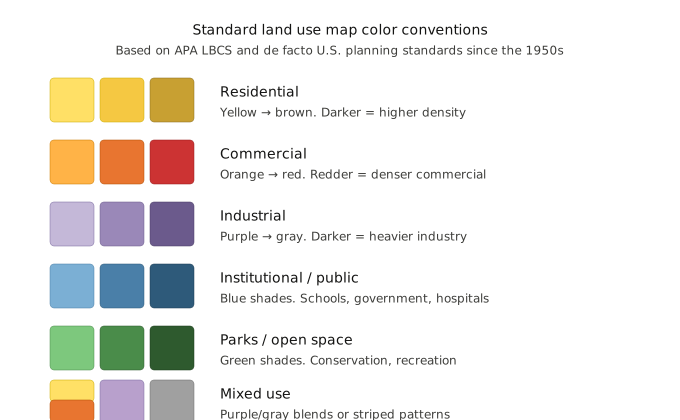 Standard land use map color conventions based on APA LBCS standards. Each jurisdiction may adapt these, so always check the map legend.
Residential areas are rendered in shades of yellow to brown. Lower-density uses like single-family homes tend toward light yellow, while higher-density uses like apartments and high-rises move toward darker gold and brown tones.[6]
Commercial areas appear in shades of orange to red. The more intense the commercial use, the redder the color. Some jurisdictions use pink for tourist-oriented commercial districts.
Industrial zones are typically shown in grays or purples. Heavier industrial uses—manufacturing, processing, warehousing—get darker shades, while light industrial or flex space may be lighter purple.[7]
Institutional and public uses—schools, hospitals, government buildings—are usually rendered in blue.
Open space and parks are green. Agricultural land may appear in lighter green or olive tones.
Mixed-use areas, which have become increasingly common in modern zoning codes, are often shown in striped patterns or combinations of purple and gray.[8]
# Color ramping: density within a category
Within any single category, jurisdictions use a technique called color ramping, a graduated shading from light to dark to indicate increasing density or intensity. A zoning map for a mid-sized city might show four or five different residential zones, each a slightly darker shade of yellow, running from rural residential at the lightest end to high-rise multi-family at the darkest.[9]
This is where the LBCS system's guidance on RGB values becomes practical. Rather than relying on color names, the standard recommends specifying exact RGB values to ensure consistency across print and digital formats.[10]
Never assume you know what a color means without checking the legend. Every jurisdiction can adapt these conventions, and many do. A shade of orange that means "neighborhood commercial" in one city might mean "general commercial" in the next.
# Zoning Maps vs. Future Land Use Maps: What's the Difference?
This distinction trips up more investors than almost any other aspect of municipal land use data.
The zoning map reflects what is legally allowed on a property right now. It's adopted as part of the municipality's land development regulations and has the force of law. If a parcel is zoned R-1, you can build what the R-1 district permits and nothing more unless you obtain a variance or rezoning.[11]
The future land use map is a policy document, not a regulatory one. It reflects the community's long-term vision for how land should be used, as expressed in the comprehensive plan. A FLUM designation of "High Density Residential" doesn't mean you can build apartments today. It means the jurisdiction has indicated that, over time, it would be receptive to rezoning that area for denser housing.[12]
Here's where it gets strategically important for investors: in many states, zoning must be consistent with the comprehensive plan's future land use designations. In Florida, for example, state statute requires that zoning be consistent with the adopted FLUM.[13] This means a FLUM that designates a currently agricultural parcel as "Mixed Use Center" is a strong signal that a rezoning application aligned with that designation has political support.
Conversely, if you want to rezone a property to a use that's inconsistent with the FLUM, you'll likely need to amend the comprehensive plan first, a longer, more expensive, and more politically fraught process.[14]
The smart play is to compare both maps side by side. Where the zoning map and FLUM disagree, there's either an opportunity (the area is planned for more intense use than what's currently zoned) or a warning (the community is signaling that it wants to downzone or preserve the area).
# Overlay Districts: The Hidden Layer That Changes Everything
If base zoning is the foundation, overlay districts are the fine print and they can fundamentally change what's buildable on a site.
An overlay district is a special zoning district layered on top of one or more existing base zoning districts. It imposes additional regulations or incentives that apply in addition to whatever the underlying zoning already requires.[15] Think of it as a transparency laid over the base zoning map, adding another set of rules to properties within its boundaries.
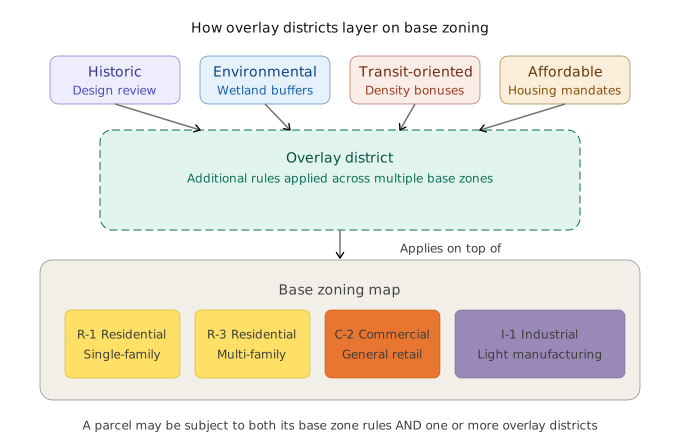 Overlay districts span across multiple base zoning categories, adding additional regulations to all parcels within their boundaries.
# Common types of overlay districts
The table below summarizes the overlay district types you're most likely to encounter, what they regulate, and how they typically affect a development project's cost and timeline.
| Overlay Type | Purpose | Typical Regulations | Map Indicator | Impact on Development |
|---|---|---|---|---|
| Historic Preservation | Protect architecturally or culturally significant neighborhoods and buildings | Exterior design review, material restrictions, demolition controls, signage limits | Hatching or distinct border over historic area | High — adds design review board approval (often 2-6 months), limits exterior modifications, may require historically compatible materials that cost more[16] |
| Environmental / Conservation | Protect floodplains, wetlands, steep slopes, watersheds, drinking water zones | Increased setbacks from natural features, impervious surface limits, stormwater requirements, prohibited uses (e.g., chemical storage near wellheads) | Green or blue-green hatching, often following natural feature boundaries | High — may render portions of a site unbuildable, trigger environmental impact studies, or require mitigation that adds six figures to project costs[17] |
| Flood Zone (FEMA) | Reduce risk to life and property in flood-prone areas | Elevated construction, flood-proofing requirements, restrictions on below-grade habitable space, mandatory flood insurance | Blue shading or cross-hatching along waterways | Moderate to High — increases construction costs (elevation, flood-proofing), raises insurance premiums, may restrict ground-floor uses |
| Transit-Oriented Development (TOD) | Encourage dense, walkable, mixed-use development near transit | Increased density allowances, reduced or eliminated parking minimums, pedestrian-oriented design standards, mixed-use permissions | Circle or radius boundary around transit stations | Positive — typically relaxes restrictions, increases developable density, reduces parking costs[18] |
| Affordable Housing | Incentivize or mandate inclusion of affordable units | Density bonuses (often 20-35% above base), reduced setbacks, expedited permitting, fee waivers in exchange for affordable units | Varies — may use distinct color or text label | Positive — provides incentives that can improve project economics, though affordability requirements reduce per-unit revenue[19] |
| Airport / Runway Clear Zone | Protect airspace and limit noise-sensitive uses near airports | Height restrictions (often stricter than base zoning), prohibition of certain uses (schools, hospitals), noise insulation requirements | Concentric zones radiating from runway | Moderate — height caps may reduce achievable density, noise requirements add construction cost |
| Corridor / Highway | Guide development character along major transportation routes | Architectural standards, landscaping buffers, sign controls, access management (curb cut restrictions), setback increases | Linear overlay following road alignment | Low to Moderate — primarily adds design requirements and may limit curb cuts, which affects site layout for commercial uses |
| Community Design Overlay | Maintain or establish a specific aesthetic character | Architectural style guidelines, material palettes, facade articulation requirements, streetscape standards | Distinct border around a defined neighborhood or commercial area | Moderate — requires design review approval, may increase architectural costs, but rarely changes permitted uses or density |
| Planned Unit Development (PUD) | Allow flexible, master-planned development that departs from standard zoning | Negotiated on a project-by-project basis — can modify uses, density, setbacks, open space requirements | Distinct boundary with PUD label | Variable — provides flexibility but requires a negotiated approval process with the jurisdiction, often including community input |
Several of these overlay types deserve additional context for investors and developers.
Historic preservation overlays are among the most impactful because they affect nearly every visible aspect of a project. Any change to a building's exterior—including roofing materials, window replacements, paint colors, and even fencing—typically requires approval from a historic preservation board. In cities like Los Angeles, HPOZs govern a review process that applies to both new construction and alterations to existing structures.[16] The additional review cycle can add months to your timeline and require design changes that increase costs.
Environmental and conservation overlays can be project-killers if you don't catch them early. An overlay around a municipal water supply well, for example, may prohibit uses involving chemical storage, impose secondary containment requirements for any hazardous materials, and require enhanced site plan review that wouldn't apply under the base zoning alone.[17] Floodplain overlays carry the added cost of mandatory flood insurance and elevated construction standards.
Transit-oriented development overlays are the rare overlay that works in a developer's favor. Cities like Los Angeles have used specific plans and TOD overlays to encourage denser, mixed-use development near transit stations often with significantly reduced parking requirements that can save hundreds of thousands of dollars in construction costs on urban projects.[18]
Affordable housing overlays offer a middle ground between regulation and incentive. In San Mateo County, for example, housing overlay zones provide developers with density bonuses and expedited permitting in exchange for including affordable units without requiring the jurisdiction to go through a full general plan amendment.[19] These overlays can make otherwise marginal projects financially viable by allowing more units on the same parcel.
# Why overlays matter for due diligence
Overlay districts are what one real estate law firm calls "a trap for the unwary."[20] A developer who checks the base zoning and stops there may discover (after ordering materials, commissioning architectural drawings, or closing on the property) that an overlay imposes additional restrictions that make the project infeasible or substantially more expensive.
The risk is compounded by the fact that overlay information isn't always obvious on the zoning map. Some jurisdictions use hatching or cross-hatching to indicate overlays; others list them separately. If you call the zoning office and ask about a property's zoning designation, the response may only address the base zoning unless you specifically ask about overlays.[21]
For a deeper dive into how overlay restrictions interact with the entitlement timeline, see our guide to the land entitlement process.
# How to Conduct a Zoning Property Search
Pulling zoning data for a specific parcel is more accessible than it's ever been, but the process still involves several steps and skipping any of them can leave gaps in your due diligence.
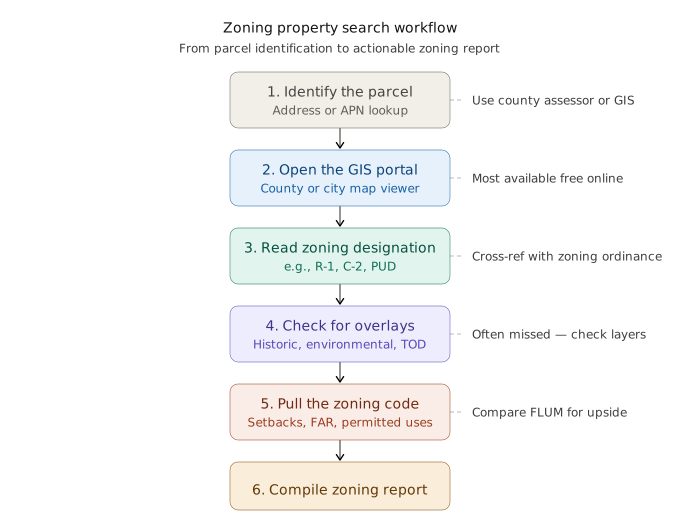 A six-step process for researching the zoning of a target property.
# Step 1: Identify the parcel
Start with the property address or the Assessor's Parcel Number (APN). The APN is the most reliable identifier because it's unique to the parcel and doesn't change with property transfers. You can find it on county assessor websites, property tax records, or title documents.
# Step 2: Find the jurisdiction's GIS portal
Most cities and counties now publish interactive zoning maps through GIS (Geographic Information System) web portals. Search for "[city/county name] GIS viewer" or "[city/county name] zoning map." Many use platforms like ArcGIS Online or MapGeo that allow you to search by address, click on parcels, and view zoning information in pop-up windows.
# Step 3: Pull the zoning designation
Once you've located the parcel on the GIS viewer, note the zoning code, the alphanumeric designation like R-3, C-1, PUD, or M-2. This code corresponds to a specific zoning district in the jurisdiction's zoning ordinance.
# Step 4: Read the zoning ordinance
The zoning code alone doesn't tell you what you need to know. You need to find the full zoning ordinance text for that district, which defines permitted uses (by right), conditional or special uses (requiring additional approval), prohibited uses, and all dimensional standards such as setbacks, height limits, lot coverage, FAR, minimum lot size, and parking requirements.
Most jurisdictions publish their zoning ordinances online through Municode, American Legal Publishing, or their own municipal websites.
# Step 5: Check for overlay districts
This is the step that separates thorough due diligence from the kind that gets you into trouble. Go back to the GIS viewer and toggle on overlay layers—historic districts, flood zones, conservation areas, TOD zones, and any other overlays the jurisdiction uses. If the parcel falls within an overlay, pull the overlay regulations from the zoning ordinance and review the additional requirements.
# Step 6: Compile a zoning report
A zoning report should document the base zoning designation, all applicable overlay districts, permitted and conditional uses, dimensional standards, any known pending amendments, and the future land use designation from the comprehensive plan. This document becomes a critical piece of your acquisition due diligence package.
GatherGov can accelerate this entire process by aggregating zoning data, municipal codes, and land use designations into a single searchable platform — saving you hours of clicking through fragmented GIS portals and PDF ordinances.
# Reading the Zoning Report: What to Look For
Once you've compiled zoning data for a target property, you need to know how to interpret the key metrics that will drive your project's feasibility.
Permitted vs. conditional uses. Permitted uses are allowed by right. No special approval needed beyond standard building permits. Conditional uses (sometimes called special exceptions) require a public hearing and approval from a planning commission or zoning board. Conditional use approval is not guaranteed and typically comes with conditions that add cost and time.[22]
Floor Area Ratio (FAR). This ratio defines the maximum buildable square footage relative to lot size. A FAR of 2.0 on a 10,000-square-foot lot means you can build up to 20,000 square feet of floor area. FAR is often the single most important number for determining a project's revenue potential.
Setbacks. The required distance between the building and the property line—front, side, and rear. Setbacks directly impact the buildable envelope and, by extension, the achievable FAR.
Height limits. Maximum building height in feet or stories. This interacts with FAR to determine your building form. A generous FAR with a low height limit means you're building wide; a high height limit with limited FAR means you're building narrow.
Density. For residential projects, density is often expressed as dwelling units per acre. This caps the number of units regardless of what the FAR and height limits might otherwise allow.
Parking requirements. Minimum off-street parking ratios can make or break a project's economics, especially for urban infill sites where structured parking costs $30,000 to $60,000 per space. Check whether the jurisdiction offers any parking reductions for transit proximity, shared parking agreements, or affordable housing.
For a focused look at how these metrics apply to retail, office, and industrial projects, see our commercial zoning guide.
# Common Mistakes Developers Make When Reading Land Use Data
Even experienced developers get tripped up by zoning data. Here are the errors that come up most often.
Confusing the FLUM with current zoning. A future land use designation of "Town Center Mixed Use" does not mean you can build mixed-use today. It means the jurisdiction is open to rezoning the area for that use—eventually, after a public process. Don't underwrite a deal based on FLUM categories without verifying the actual zoning.
Missing overlay restrictions. As covered above, overlay districts add rules that don't show up in the base zoning designation. Historic overlays are the most commonly overlooked because they don't change the underlying use permissions. They add design review requirements that can slow a project by months and require expensive architectural revisions.
Relying on outdated maps. Zoning maps change. Jurisdictions rezone properties, adopt new overlay districts, and amend their comprehensive plans. A zoning map PDF downloaded six months ago may not reflect recent amendments. Always verify against the most current GIS data or call the planning department directly.
Not reading the ordinance text. The color on the map tells you the zone. The ordinance text tells you what the zone actually allows. Many developers stop at the map and assume they understand the rules, then discover that the specific lot coverage limit, or an obscure accessory use restriction, or a landscaping buffer requirement makes their project configuration infeasible.
Ignoring pending amendments. Check whether any rezoning applications, comprehensive plan amendments, or overlay district proposals are pending for the area around your target property. A pending downzoning or a proposed historic overlay can dramatically affect your project—and these are public record if you know where to look.
# How AI Is Changing Zoning Research
The traditional zoning property search process—clicking through GIS portals, downloading PDF ordinances, manually cross-referencing overlay maps—is slow, fragmented, and error-prone. It's exactly the kind of workflow that AI is transforming.
Municipal zoning data has historically been one of the hardest datasets in real estate to work with. Every jurisdiction codes its districts differently, publishes its ordinances in different formats, and updates its GIS data on its own schedule. There's no national standard for zoning codes, which means a "C-2" in Phoenix means something entirely different from a "C-2" in Philadelphia.[23]
AI-powered tools are beginning to solve this by normalizing zoning data across jurisdictions, extracting key dimensional standards from ordinance text, and flagging overlay restrictions automatically. Instead of spending hours on a single parcel's zoning research, investors can now screen entire portfolios of potential acquisitions against their zoning criteria in minutes.
For a broader look at how these tools are reshaping the industry, see our overview of how AI is changing real estate data.
GatherGov is built specifically for this use case—giving developers, investors, and land use professionals a single platform to search, analyze, and report on rezoning sentiment across municipalities.
# Frequently Asked Questions
# What do the colors on a zoning map mean?
Colors on a zoning map represent different land use categories. Yellow typically indicates residential zones, red or orange means commercial, purple or gray signals industrial, green represents parks and open space, and blue usually designates institutional or public uses. Darker shades within a color family indicate higher density or intensity. Every jurisdiction adapts these conventions, so always check the map's legend before interpreting.
# How do I find the zoning for a specific property?
Start by searching for your city or county's GIS portal online—most jurisdictions offer free interactive zoning viewers. Enter the property address or parcel number, and the viewer will display the zoning designation. Then cross-reference that designation against the zoning ordinance text to understand what uses, setbacks, and density limits apply.
# What is the difference between a land use map and a zoning map?
A land use map can refer to either an existing land use map (which shows how land is currently being used) or a future land use map (which shows how the jurisdiction plans for land to be used). A zoning map is a regulatory document that shows what is legally permitted on each parcel right now. Zoning maps have the force of law; future land use maps are policy guides.
# What is an overlay district and how does it affect my property?
An overlay district is a secondary zoning layer placed on top of base zoning that imposes additional regulations. Common overlays include historic preservation districts, flood zones, transit-oriented development zones, and environmental conservation areas. If your property falls within an overlay, you must comply with both the base zoning rules and the overlay's additional requirements.
# What is a zoning report and what should it include?
A zoning report is a due diligence document that summarizes all the zoning regulations applicable to a specific property. It should include the base zoning designation, all overlay districts, permitted and conditional uses, dimensional standards (setbacks, height, FAR, lot coverage), parking requirements, the future land use designation, and any known pending zoning amendments.
# Can the future land use map change my property's zoning?
No a future land use map designation does not automatically change zoning. Any zoning change requires a formal rezoning process, including public hearings before the planning commission and governing body. However, the FLUM strongly influences whether a rezoning application will be approved, because many states require zoning to be consistent with the comprehensive plan.
# Image Credits and Licensing Notes
- Zoning Map Color Legend: Original SVG diagram. Free to use.
- Overlay District Concept Diagram: Original SVG diagram. Free to use.
- Zoning Property Search Workflow: Original SVG diagram. Free to use.
- Supplemental map screenshots: Municipal zoning maps and GIS viewer screenshots from U.S. government sources are generally in the public domain. OpenStreetMap base maps are available under CC BY-SA 2.0 with attribution to OpenStreetMap contributors.
- Freepik: Zoning/land use vector illustrations available with attribution under Freepik's free license at freepik.com/free-photos-vectors/zoning-map.
- Wikimedia Commons: The Land use maps category contains 47+ files, many under CC BY-SA or public domain, at commons.wikimedia.org/wiki/Category:Land_use.
# Footnotes
-
Fenstermaker, "What is Land Use Mapping?" (2022). Land use mapping classifies different types of land as well as their distribution and use geospatially within a region. ↩
-
University of Wisconsin-Stevens Point Center for Land Use Education, "Three Most Common Land Use Tools." The zoning ordinance contains two legally adopted components: the zoning map and the ordinance text. ↩
-
JB Professional Group, "The Relationship Between Future Land Use and Zoning" (2023). Future land use categories designate the general location, distribution, and extent of land uses within a community through the comprehensive plan. ↩
-
Scribd / UP503 Land Use lecture notes. U.S. planning agencies have been using a de facto standard color scheme for land use maps since the 1950s. ↩
-
American Planning Association, Land Based Classification Standards (LBCS). The LBCS model classifies land uses across five dimensions: activity, function, structure type, site development character, and ownership, each with standardized color codes. ↩
-
Michigan State University Extension, "Standardized Land Use and Thematic Map Colors" (2008). For zoning and future land use maps, color conventions follow association with the topic, with yellows for residential, reds for commercial, and shading intensity correlating with density. ↩
-
GIS Manual, "Traditional Color Coding for Land Uses." Industrial uses are rendered in grays or shades of purple, with heavier industry receiving darker shading. ↩
-
GIS Manual, "Traditional Color Coding for Land Uses." Mixed uses are designated a range of colors in the purple or gray shades, with purple shades covering commercial-residential mixed use and gray shades covering office-light industry mixed use. ↩
-
American Planning Association, LBCS Standards, Color Codes. LBCS recommends ramping techniques where a color value is graduated to increasing or decreasing shades within a category. ↩
-
American Planning Association, LBCS Standards, Color Codes. The standards recommend specifying RGB values rather than relying on color names for consistent reproduction across print, plotters, and screens. ↩
-
Abrams Law Firm, "Understanding the Distinction Between Land Use and Zoning" (2024). Zoning represents the current permissible uses of specific properties within a given jurisdiction and has independent legal significance from land use designations. ↩
-
Anne Arundel County Plan2040, "What is the Land Use Map?" The Land Use Map depicts planned or future land use designations providing general guidance on density, character, and location of land uses. ↩
-
JB Professional Group, "The Relationship Between Future Land Use and Zoning" (2023). Pursuant to Florida's Growth Policy Act, F.S. 163, each future land use category must define allowable land uses, population densities, and building intensities. ↩
-
Abrams Law Firm, "Understanding the Distinction Between Land Use and Zoning" (2024). In Florida, zoning must not be inconsistent with land use designations. In the event of conflict, a land use amendment would be required, a process more likely to invite public challenge. ↩
-
Planetizen Planopedia, "What Is an Overlay District?" (2024). An overlay district is a geographic zoning district layered on top of another existing zoning district that implements additional regulations. ↩
-
City of Los Angeles Planning Department, "Plan Overlays." Historic Preservation Overlay Zones (HPOZs) govern the review of project applications, addressing exterior alterations or additions to historic properties. ↩ ↩[2]
-
MSU Extension, "Overlay Zoning Districts Can Be a Valuable Tool" (2023). An overlay district around a public water well, for example, may have additional site plan review requirements for secondary containment and may prohibit high-risk land uses. ↩ ↩[2]
-
City of Los Angeles Planning Department, "Plan Overlays." Specific Plans like the Vermont-Western Transit Oriented District include development regulations aligned with General Plan and Community Plan goals. ↩ ↩[2]
-
Home for All San Mateo County, "Housing Overlay Zones." HOZs provide incentives for developers including density bonuses, expedited permitting, and flexibility to build housing without the lengthy process of amending a general plan. ↩ ↩[2]
-
McBrayer PLLC, "Overlay Zoning" (2014). Overlay zones can add significant time and cost to projects, especially if an owner is unaware that the property is subject to overlay regulations in addition to underlying zoning. ↩
-
McBrayer PLLC, "Overlay Zoning" (2014). If an owner calls the zoning office to ask about permits, the response may omit overlay requirements unless the specific question is asked. ↩
-
University of Wisconsin-Stevens Point Center for Land Use Education, "Overlay Zoning." Overlay regulations can address uses, design, density, and protections to guide development within a special area, applied in addition to underlying base zoning. ↩
-
Urban Institute, "Who Zones? Mapping Land-Use Authority across the US" (2025). No federal entity oversees or stores data on who zones what land, and zoning laws are riddled with localized idiosyncrasies that make cross-jurisdictional standardization difficult. ↩