
Real estate has always run on gut and geography. Agents know which neighborhoods are appreciating because they've spent years on the ground. That regional knowledge is enormously valuable. It is also nearly impossible to scale.
The problem is structural. Permit histories live in county databases with no standardization. Zoning records are scattered across thousands of municipal websites, each with its own format and update cadence. Previous efforts to centralize real estate data hit the same wall: the manual collection task was simply too large.
AI is changing that. Here are five ways it's happening.
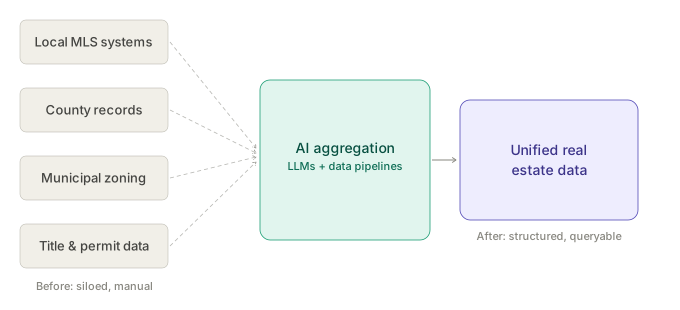
 AI tools are turning siloed, regional real estate data into a unified, queryable layer.
# 1. Automating Government Real Estate Data Collection
Understanding what's buildable on a parcel used to mean calling planning departments and reading zoning code written in legal prose, or paying someone who already had that knowledge. AI tools for real estate data can now do that at scale, parsing unstructured PDFs, extracting permit records, and standardizing information across jurisdictions automatically.
GatherGov is built specifically for this problem. It uses AI to collect and structure government data—permits, zoning, entitlements—across jurisdictions, giving developers and investors the kind of local intelligence they previously had to source manually. This includes tracking active government RFPs that signal upcoming public real estate projects — a layer most investors miss entirely. Understanding the zoning laws and land entitlement process for a target market used to require years of local expertise. AI tools are making that intelligence accessible on demand.
# 2. Building Universal Property Data Graphs
One of the biggest challenges in real estate data collection has always been reconciliation: the same property might appear differently across dozens of sources with different parcel IDs, ownership structures, address formats. AI-powered platforms are now solving this at a scale that was previously unimaginable.
Cherre built a Universal Data Model that standardizes disparate real estate data sources into a coherent knowledge graph, connecting over 3.3 billion addresses.[1] What used to require a team of data analysts to reconcile across spreadsheets can now be queried in seconds. The platform's semantic data layer transforms hundreds of inconsistent source formats into a single usable structure.
# 3. Making Property Valuations More Accurate (and More Consistent)
Automated valuation models (AVMs) aren't new. What AI changes is the accuracy, coverage, and consistency of those models, particularly across geographies that were previously underserved.
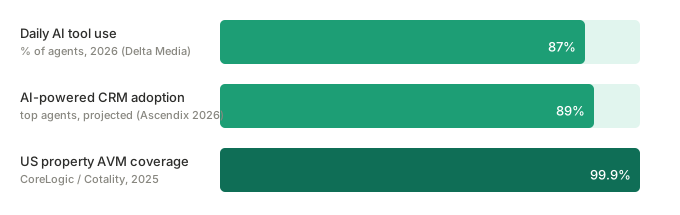
CoreLogic, recently rebranded as Cotality, now achieves 99% accuracy across its AVM and covers 99.9% of US properties, drawing on over 3 billion historical records.[2] A single consistent methodology reduces the variance that plagued earlier multi-model approaches, where results would shift dramatically depending on which regional model was activated. For investors underwriting deals across multiple markets, that consistency is significant.
 AI adoption across real estate is accelerating quickly from daily tool use to CRM integration to property data coverage.
# 4. Giving Real Estate Agents Smarter Search and Lead Intelligence
For ai tools for real estate agents, the day-to-day changes are showing up in two areas: search and client management.
Conversational search tools now let buyers describe what they want in plain language—"craftsman with a two-car garage in a neighborhood with sidewalks and parks"—and get matched to listings based on intent rather than filter combinations.[3] Early adopters have seen significant lifts in client engagement, with the AI reactivating stale databases by surfacing buyers who match newly listed properties they might have missed.
On the CRM side, AI-enhanced platforms are projected to be used by nearly 89% of top agents in 2026.[4] Agentic platforms can now handle lead qualification, follow-up cadencing, and portfolio monitoring with minimal manual input,
# 5. Tracking How AI Infrastructure Is Reshaping Property Markets
AI in real estate now operates as both a tool and a force. AI isn't just helping analyze real estate. It's also actively reshaping demand across property types. Data centers require power, land, and specific infrastructure. Industrial facilities near AI campuses benefit from logistics proximity. Office demand in some markets is declining while specialized tech-adjacent space rises.
Cushman & Wakefield launched its AI Impact Barometer in February 2026—the first tool of its kind in commercial real estate—designed to quantify how AI adoption is influencing property demand across sectors.[5] It brings together economic, capital markets, and property indicators to track how AI is shifting from an experiment to a structural force in the built environment.
# The Bottom Line
The industry's informational moats are narrowing. Regional expertise still matters. No model knows a neighborhood the way a 20-year local agent does. But AI tools for real estate data are raising the floor, giving investors and developers access to structured intelligence that previously required years on the ground to acquire.
The agents and investors who adapt early will move faster, underwrite more accurately, and find opportunities that others miss.
# Frequently Asked Questions
What are the best AI tools for real estate agents in 2026? The most widely adopted AI tools for real estate agents include AI-powered CRMs (such as Salesforce Agentforce and Lofty), conversational listing search platforms like HomeSearch AI, and document processing tools that automate lease abstraction and compliance review. Over 87% of agents now use some form of AI tool daily.[4]
How is AI being used in real estate data collection? AI is being used to parse government databases, extract permit records, standardize zoning information across jurisdictions, reconcile property ownership records, and build unified data graphs connecting billions of property addresses. The key advantage over previous approaches is scale—tasks that would take a research team months can now run continuously and automatically.
What is real estate data and why is it hard to access? Real estate data refers to the information needed to understand a property or market: ownership records, permit history, zoning designations, transaction history, valuation data, and local regulatory context. It's historically hard to access because it lives in hundreds of disconnected local systems each with its own format and update cadence.
Can AI replace real estate agents? Not in any near-term sense. AI tools are most effective at eliminating administrative and research work. The relationship skills, local instincts, and negotiation judgment that characterize top agents remain hard to replicate. The more likely outcome is that agents who use AI tools outperform those who don't.
# Footnotes
-
Cherre, "Universal Data Model," via V7 Labs, The Best AI Tools for Real Estate: A 2026 Field Guide, 2026. ↩
-
CoreLogic/Cotality, Total Home ValueX product overview, via V7 Labs, 2026. ↩
-
Inside Real Estate, HomeSearch AI, via Florida Realtors, December 2025. ↩
-
Ascendix Technologies, AI for Real Estate Agents: 35+ Tools to Use in 2026, March 2026; Delta Media, 2026. ↩ ↩[2]
-
Cushman & Wakefield, press release, February 19, 2026. ↩