
There are 90,498 local government entities in the United States.[1] structured in terms of counties, municipalities, townships, school districts, and special districts, with each entity having its own authority to levy taxes, approve permits, and regulate land use.
If you're buying, building, or investing in real estate, these are the governments are often the ones that determine what you can do with a property. This guide breaks down the five types of local government, explains how they get their powers, and shows through real case studies why America's decentralized system creates both opportunity and complexity for anyone in commercial real estate.
# The Five Types of Local Government
The U.S. Census Bureau classifies local governments into five types: counties, municipalities, townships, special districts, and school districts.[2] The first three are general-purpose governments that deliver a broad range of services within a defined territory. The last two are special-purpose governments created to handle specific functions.
 How the 90,498 Local Governments Are Divided
# Counties
Every state except Connecticut and Rhode Island has functioning county governments.[3] Counties were originally created as administrative extensions of the state — they collected taxes, maintained roads, ran courts, and recorded deeds on the state's behalf. Today, there are 3,031 county governments in the United States.[1]
County governments go by different names in different states. In Louisiana, they're called parishes. In Alaska, they're boroughs. But the function is similar: counties provide services across a broad geographic area that typically encompasses multiple municipalities and unincorporated land.
The internal structure of county government varies. Some counties operate under a commission system, where elected commissioners serve as both the legislative and executive branch. Others use a council-administrator system, hiring a professional manager to run day-to-day operations while the elected council sets policy. A smaller number use a council-elected executive system, with a separately elected county executive, similar to a mayor, who oversees the administration.[4]
For real estate, county government matters because it controls land use in unincorporated areas, administers property tax assessments, and often runs the permitting process for projects outside city limits.
# Municipalities
Municipal governments—cities, towns, boroughs, and villages—are the local governments most people interact with directly. There are approximately 19,502 municipal governments in the United States, ranging from New York City (population 8.3 million) to towns with fewer than 100 residents.[1]
Municipalities are organized around population centers and typically provide the densest layer of local government services such as police, fire, water, sewer, parks, zoning enforcement, and building permits. Unlike counties, which are created by the state, municipalities are usually incorporated by local residents who petition for self-governance.
The three most common forms of municipal government are:
Mayor-council: An elected mayor serves as the chief executive, and an elected council serves as the legislative body. This is the oldest form of municipal government in the United States and is used by most of the nation's largest cities, including New York, Chicago, and Houston.[5]
Council-manager: The elected council hires a professional city manager to handle administration. The mayor, if the position exists, is typically ceremonial. This form is common in mid-size cities and suburbs like Phoenix, Dallas, and San Antonio.[5]
Commission: Elected commissioners each oversee a specific department (public works, public safety, finance) while collectively serving as the legislative body. This form is less common today but still exists in some smaller municipalities.[5]
# Townships
Townships exist in 20 states, primarily in the Northeast and Midwest, and there are 16,214 of them nationally.[1] Their powers vary enormously. In New England, towns function as full-service municipal governments, in many cases predating both their county and their state. The New England town meeting, where residents gather to vote directly on budgets and ordinances, remains one of the most direct forms of democracy in the country.[6]
Outside New England, townships typically have more limited authority. In states like Illinois, Indiana, and Michigan, townships handle road maintenance, property assessment, and general assistance programs but they operate alongside (and sometimes overlap with) county and municipal governments.
# Special Districts
Special districts are the most numerous and least understood type of local government. There are 39,555 of them, more than counties, municipalities, and townships combined.[1] They are single-purpose (or limited-purpose) entities created to deliver a specific service: water supply, transit, parks, hospitals, and dozens of other functions.
Special districts exist because general-purpose governments either couldn't or wouldn't provide a needed service. A rural area outside city limits might form a fire protection district. A region spanning multiple counties might create a transit authority. A neighborhood might establish a business improvement district to fund streetscape upgrades.
Each special district typically has its own governing board, some elected, most appointed, and many have independent taxing authority.[7] This means a single property can be subject to taxes from a county, a city, a school district, and multiple special districts simultaneously, each with its own budget, board, and public meeting schedule.
The growth of special districts has been the defining trend in American local governance over the past 70 years. In 1952, there were 12,340 special districts in the United States. By 2022, that number had more than tripled to 39,555.[1] This expansion reflects both the increasing demand for specialized services and the political difficulty of expanding the powers of existing governments.
# School Districts
School districts are technically a subset of special-purpose governments, but the Census Bureau tracks them separately because of their scale and importance. There are 12,546 school districts in the United States, down dramatically from 67,355 in 1952, due to decades of state-encouraged consolidation.[1]
School districts have their own elected boards, their own taxing authority, and their own budgets. In many communities, the school district's property tax levy is the single largest component of a homeowner's tax bill. For commercial real estate investors, school district quality is a material factor in residential property values and, by extension, in the demand profile for retail and mixed-use development in a given area.
# How Local Governments Get Their Powers
The U.S. Constitution says nothing about local government. The Tenth Amendment reserves all powers not granted to the federal government to the states and the people.[8] This means every local government in America derives its authority from its state. But the amount of authority a state grants varies dramatically.
Two legal doctrines govern the relationship between states and their local governments: Dillon's Rule and Home Rule.
Dillon's Rule, named after Iowa Supreme Court Justice John F. Dillon, holds that local governments possess only three categories of power—those explicitly granted by the state, those necessarily implied from the grant of power, and those essential to the existence of the government itself. If there is any reasonable doubt about whether a local government has a particular power, the power is denied.[9] The U.S. Supreme Court upheld this principle in 1907 in Hunter v. City of Pittsburgh.[10]
Home Rule is the counterweight. States that grant home rule authority allow their local governments to exercise any power not specifically prohibited by state law. Home rule provisions are typically established in a state's constitution or by statute, and they vary in scope. Some states grant broad functional home rule (the power to legislate on any local matter). Others grant only structural home rule (the power to choose a form of government) or fiscal home rule (the power to set tax rates and revenue sources).[11]
In practice, most states apply a blend of both doctrines. The National League of Cities identifies 31 states that apply Dillon's Rule to at least some local governments, 10 that are fully home rule states, and the remainder that apply different rules to different types of municipalities.[12] For example, Texas grants home rule to cities with more than 5,000 residents, while smaller cities operate under Dillon's Rule.[12]
This matters for real estate because the scope of local government powers directly determines what a jurisdiction can regulate. A home rule city might adopt its own inclusionary zoning ordinance or impose impact fees on new development without waiting for state authorization. A Dillon's Rule city might need to lobby its state legislature for the same authority, a process that can take years.
# Why America Has So Many Governments: A Brief History
 The Local Governance Composition of Each State Differs Due to Its History
America's local governance system grew from the bottom up.
As Alexis de Tocqueville observed in 1835, "the township was organized before the county, the county before the State, the State before the Union."[13] When European settlers established communities in North America, they created their own governing institutions—town meetings, county courts, parish councils—out of practical necessity. These institutions were already entrenched by the time state and federal governments formed around them.
This bottom-up history produced the defining feature of American local governance: no two states, and often no two cities within the same state, have the exact same government structure.
The practical consequence has been a system that innovates locally but resists standardization nationally. New York City adopted the country's first comprehensive zoning ordinance in 1916, decades before federal land use policy existed.[14] But that same independence means that a developer working across state lines (or even across county lines) faces a different regulatory environment at every stop.
The mid-20th century brought a structural shift. Between 1952 and 2022, school districts consolidated dramatically—from 67,355 to 12,546—as states pushed for larger, more efficient systems.[1] But special districts moved in the opposite direction, nearly tripling from 12,340 to 39,555 over the same period.[1] Every new special district added another layer of taxing authority, another board, and another set of meetings to track.
For a deeper look at the data behind this structural evolution—including state-by-state breakdowns and historical trends—see our methodology on the landscape of American local governance.
# Case Study: Illinois—The Most Governed State in America
 With close to 7,000 local entities, Illinois is the most governed state in America
Illinois has more local governments than any other state: 6,930 as of the 2022 Census of Governments.[15] That count includes 102 counties, 1,433 townships, 1,288 municipalities, 944 school districts, and over 3,000 special districts. To put that in perspective, California, a state with more than three times Illinois' population, has roughly 4,500.[15]
The concentration is most extreme in Cook County, which encompasses Chicago and its inner suburbs. Cook County alone has over 240 special districts, more than ten entire U.S. states.[16] A typical homeowner in suburban Cook County might be subject to overlapping taxes from a municipality, a township, a county, a school district, a park district, a library district, a fire protection district, a mosquito abatement district, and a sanitary district—each with its own independently elected or appointed board.
This fragmentation has real costs. The Civic Federation and Better Government Association have documented cases of overlapping jurisdictions, duplicated services, and special districts that operate with minimal public oversight or accountability.[17] Recent investigations uncovered fraud and embezzlement at several Illinois special districts, facilitated by the obscurity of these entities. Many residents don't know the districts exist, let alone when their boards meet or how much they levy in taxes.[17]
The state has been slow to consolidate. Although Illinois law provides mechanisms for dissolving or merging special districts, the process requires referendums, and incumbents rarely vote to eliminate their own positions. In 2025, Governor Pritzker proposed legislation to lower the procedural hurdles for consolidation, but the bill did not pass.[18]
# Case Study: Nashville-Davidson County—What Local Government Consolidation Looks Like
In 1962, the residents of Nashville and Davidson County, Tennessee voted to merge their city and county governments into a single entity: the Metropolitan Government of Nashville-Davidson County. It was the first full city-county consolidation in the United States.[19]
The merger was born from frustration. After World War II, Davidson County's suburbs boomed while Nashville's urban core stagnated. County residents used city parks and libraries without paying city taxes. Both the city and county ran separate school systems, separate health departments, and separate road maintenance programs, duplicating costs at every level. Meanwhile, the county lacked the infrastructure to provide basic services like sewer and fire protection to its rapidly growing suburbs.[19]
A first attempt at consolidation failed in a 1958 referendum. Nashville's response was aggressive. The city annexed 42 square miles of suburban property and imposed a wheel tax on all county residents who commuted into the city. These moves, rather than resolving the conflict, enraged suburban voters and built support for a second consolidation vote.[20]
The 1962 charter passed and created a two-tier service model that addressed the core political objection to merger. The Urban Services District covered the old city boundaries and provided a full range of municipal services at a higher tax rate. The General Services District covered the entire county but provided fewer services at a lower rate. Six small incorporated communities—Belle Meade, Berry Hill, Forest Hills, Goodlettsville, Lakewood, and Oak Hill—were allowed to retain their charters as "satellite cities."[19]
Today, Nashville-Davidson is one of only about 14 consolidated city-county governments in the nation, and each subsequent consolidation has used Nashville's charter as a model.[20] The consolidation eliminated duplicated services, unified planning and zoning authority across the county, and created a single point of contact for permitting—a significant advantage for developers who would otherwise navigate separate city and county approval processes.
# Case Study: California—When the State Steps In
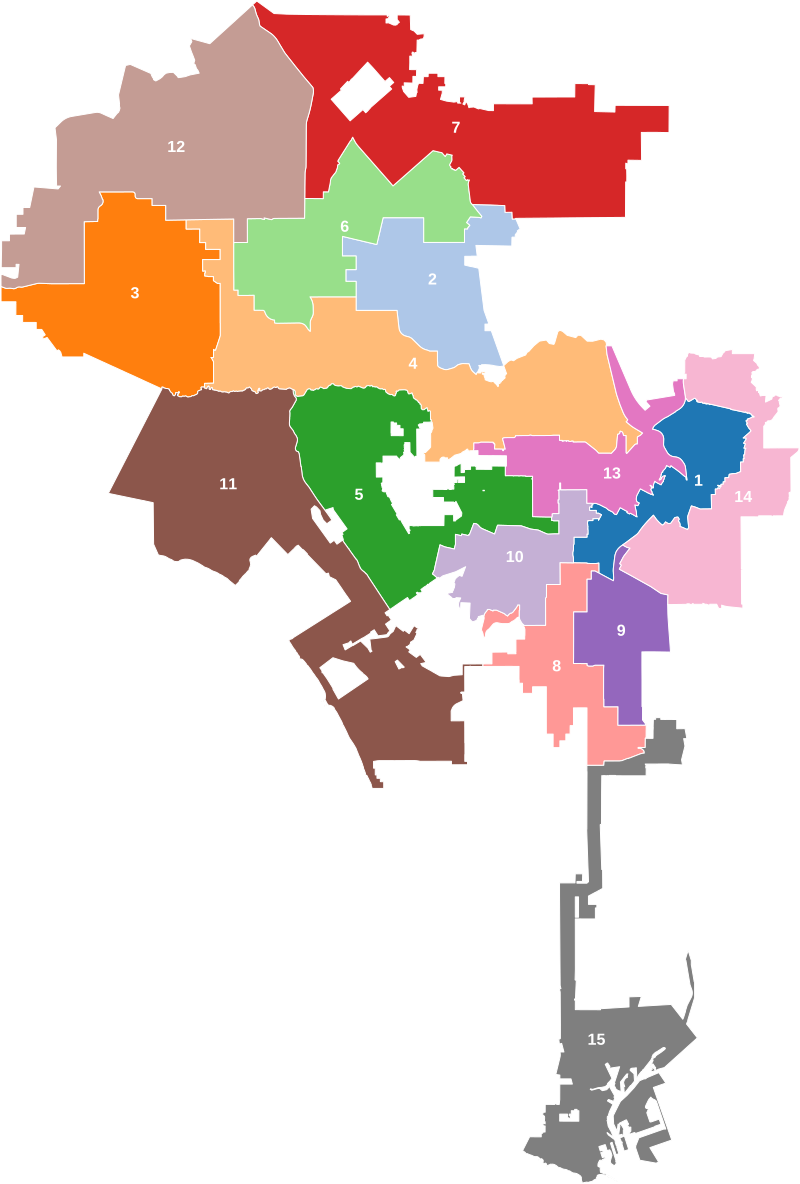 Annexation wars of the mid-20th century are the reason why so many California cities today have irregular boundaries
California took a different approach to the same problem. Rather than consolidating governments, it created a new layer of oversight to manage the chaos.
In the 1950s, California was experiencing explosive population growth. New cities incorporated rapidly, often with irregular boundaries drawn to capture tax-generating commercial properties while excluding costly residential areas. Existing cities engaged in "annexation wars," leapfrogging over undeveloped land to claim territory before competitors could. Special districts proliferated to serve areas that cities wouldn't or couldn't reach. By the early 1960s, Santa Clara County—the future Silicon Valley—had 63 special districts and a patchwork of municipal boundaries that made efficient service delivery nearly impossible.[21]
In 1963, the California Legislature responded by creating Local Agency Formation Commissions (LAFCOs) in every county.[22] LAFCOs are independent, quasi-legislative agencies whose job is to oversee the formation, expansion, and dissolution of cities and special districts. Before a new city can incorporate, a special district can form, or a city can annex territory, the proposal must go through LAFCO review.
LAFCOs evaluate proposals based on factors including population density, the adequacy of existing services, the impact on agricultural land, and the logical extension of government boundaries.[22] They can approve, deny, or impose conditions on boundary changes. The Cortese-Knox-Hertzberg Act of 2000 expanded LAFCO powers further, giving them the authority to initiate proposals for the dissolution or consolidation of special districts.[23]
The results have been mixed but measurable. In Santa Clara County, LAFCO adopted "boundary agreement lines" in 1967 that ended the annexation wars and channeled growth into defined urban service areas. Today, only 23% of the county's land area is within cities' urban service boundaries, but that area accounts for 95% of the county's 2 million residents, a pattern that has allowed the county to protect significant open space while concentrating development efficiently.[21]
In Sonoma County, LAFCO facilitated the 2019 creation of the Sonoma County Fire District by consolidating four separate fire protection entities into a single agency, with three more districts dissolved and annexed in subsequent years.[23]
# What This Means for Real Estate Development
The decentralized structure of American local government has a direct and measurable impact on real estate development timelines and costs.
A typical entitlement process can require approvals from multiple independent bodies. Each of these bodies operates on its own timeline, with its own procedural requirements, public hearing schedules, and political dynamics.
On average, developers spend two to three years on the entitlement process—and large or politically sensitive projects can take far longer. The complexity is not just about the number of steps. It's about the number of independent decision-makers, each with the power to delay or deny.
This is where tracking what's happening inside local government becomes a competitive advantage. Knowing which city council is receptive to rezoning applications, which planning commission is under political pressure to slow growth, or which special district board is considering a moratorium on new connections—that information directly affects acquisition strategy and development risk.
GatherGov continuously indexes city council meetings, planning commission agendas, and municipal documents across the country, linking entities across jurisdictions so you can see where projects stand and how local governments are moving before anyone else is paying attention.
For a walkthrough of how zoning regulations work within this system, see our complete guide to zoning laws. For the specific classifications that govern commercial properties, see our guide to commercial zoning designations C1 through C8.
# How to Research Local Government Structure Before You Invest
Before committing capital to a property, you need to know which governments have jurisdiction over it. Here's a practical research sequence.
Identify the general-purpose governments. Start with the county and municipality (if any). Most county assessor websites will tell you the property's jurisdiction. If the property is in unincorporated territory, the county is your primary regulatory body.
Find the special districts. Use the U.S. Census Bureau's Census of Governments to identify special districts in the area. Many states also maintain their own databases. California's Controller's office, for example, tracks every special district in the state. Your county assessor's tax bill will list every taxing entity that levies against the property.
Determine the government structure. Know whether you're dealing with a mayor-council city, a council-manager city, or a county commission. The structure tells you who has decision-making authority over land use and permitting. In a council-manager system, the professional staff often has significant influence over development approvals. In a strong-mayor system, the mayor's office may be the key relationship.
Monitor the political landscape. Zoning approvals, variance requests, and rezoning applications are ultimately political decisions made by elected or appointed officials. Tracking how those officials are responding to development proposals gives you a read on the political climate before you file your application.
GatherGov makes this last step scalable. Rather than manually reviewing agendas and minutes from every relevant commission, the platform surfaces development-related actions across municipalities in real time so you can identify patterns, track sentiment, and time your applications strategically.
# Frequently Asked Questions
# What are the five types of local government?
The U.S. Census Bureau classifies local governments into five types: counties (3,031), municipalities (19,502), townships (16,214), special districts (39,555), and school districts (12,546). Counties, municipalities, and townships are general-purpose governments that deliver a broad range of services. Special districts and school districts are special-purpose governments focused on specific functions.[1]
# What is the difference between a municipality and a county?
A county is a geographic subdivision of a state that provides services across a broad area, often including multiple cities and unincorporated land. A municipality — a city, town, or village — is a locally incorporated government organized around a population center. In most states, municipal and county governments operate side by side, with municipalities providing more intensive urban services (police, fire, water, sewer) within their boundaries while the county covers the gaps.[3]
# What are special districts and why do they matter?
Special districts are independent, limited-purpose governments created to deliver a specific service — such as water supply, fire protection, or transit — that existing general-purpose governments couldn't or wouldn't provide. They are the most numerous type of local government, with 39,555 nationwide, and many have independent taxing authority. They matter because they directly affect a property's tax burden and development approvals, even though most people don't know they exist.[7]
# How many local governments are in the United States?
As of the 2022 Census of Governments conducted by the U.S. Census Bureau, there are 90,498 local government entities in the United States. Illinois has the most (6,930), followed by Texas (5,533) and Pennsylvania (4,851). Hawaii has the fewest, with only 21.[15]
# What is Dillon's Rule vs. Home Rule?
Dillon's Rule holds that local governments possess only those powers explicitly granted by the state. Home Rule allows local governments to exercise any power not specifically prohibited by state law. Most states apply a blend of both doctrines. The distinction matters for real estate because it determines whether a city can adopt its own development regulations or must wait for state authorization.[9]
# What is the most common form of city government?
The two most common forms are mayor-council and council-manager. Mayor-council governments, where an elected mayor serves as chief executive, are the oldest form and are used by most large cities. Council-manager governments, where the council hires a professional administrator, are widespread in mid-size cities and suburbs. Recent surveys show the two forms are becoming less distinct as cities borrow structural features from each other.[5]
# Footnotes
# Footnotes
-
U.S. Census Bureau, 2022 Census of Governments, "Government Organization Summary Report," 2023. ↩ ↩[2] ↩[3] ↩[4] ↩[5] ↩[6] ↩[7] ↩[8] ↩[9] ↩[10]
-
U.S. Census Bureau, "About Government Organization & Structure," census.gov. ↩
-
National League of Cities, "Cities 101 — Types of Local US Governments," nlc.org. ↩ ↩[2]
-
MultiState, "Local Government 101: Structures, Laws & Business," 2026. ↩
-
National League of Cities, "Cities 101 — Forms of Local Government," nlc.org. ↩ ↩[2] ↩[3] ↩[4]
-
ICMA, "A Brief Description of Local Government Systems in the United States," icma.org. ↩
-
National League of Cities, "Cities 101 — Types of Local US Governments," Special Districts section. ↩ ↩[2]
-
The White House, "State & Local Government," whitehouse.gov. ↩
-
Nebraska Legislature, "Dillon Rule and Home Rule: Principles of Local Governance," Research Snapshot, 2020. ↩ ↩[2]
-
National League of Cities, "Cities 101 — Delegation of Power," nlc.org. See also Hunter v. City of Pittsburgh, 207 U.S. 161 (1907). ↩
-
National League of Cities, "Cities 101 — Delegation of Power," nlc.org. ↩
-
FiscalNote, "Dillon's Rule vs Home Rule: Implications for Local Government Affairs Teams," 2023. ↩ ↩[2]
-
Alexis de Tocqueville, Democracy in America, 1835. ↩
-
NYC Department of City Planning, "Zoning: About," nyc.gov. ↩
-
Federal Reserve Bank of St. Louis, "The Number and Types of Local Governments in the U.S.," Regional Economist, March 2024. ↩ ↩[2] ↩[3]
-
Illinois General Assembly Legislative Research Unit, "Legislator's Guide to Local Governments in Illinois." ↩
-
Civic Federation of Chicago & Better Government Association, "It's Time to Slash the Number of Illinois Local Governments," 2025. ↩ ↩[2]
-
Civic Federation, "Lake County Leads the Way in Local Government Consolidation," October 2025. ↩
-
Metropolitan Government of Nashville-Davidson County, "History of Metro," nashville.gov. ↩ ↩[2] ↩[3]
-
Abell Foundation, "Fifty Years After Merger: Nashville and Davidson County," 2013. ↩ ↩[2]
-
Santa Clara LAFCO, "Chapter 1: Countywide Urban Development Policies." ↩ ↩[2]
-
California Association of LAFCOs (CALAFCO), "About LAFCOs," calafco.org. ↩ ↩[2]
-
NYU Wagner, "Does Government Consolidation Lead to Cost Savings? Evidence from California," Working Paper. ↩ ↩[2]