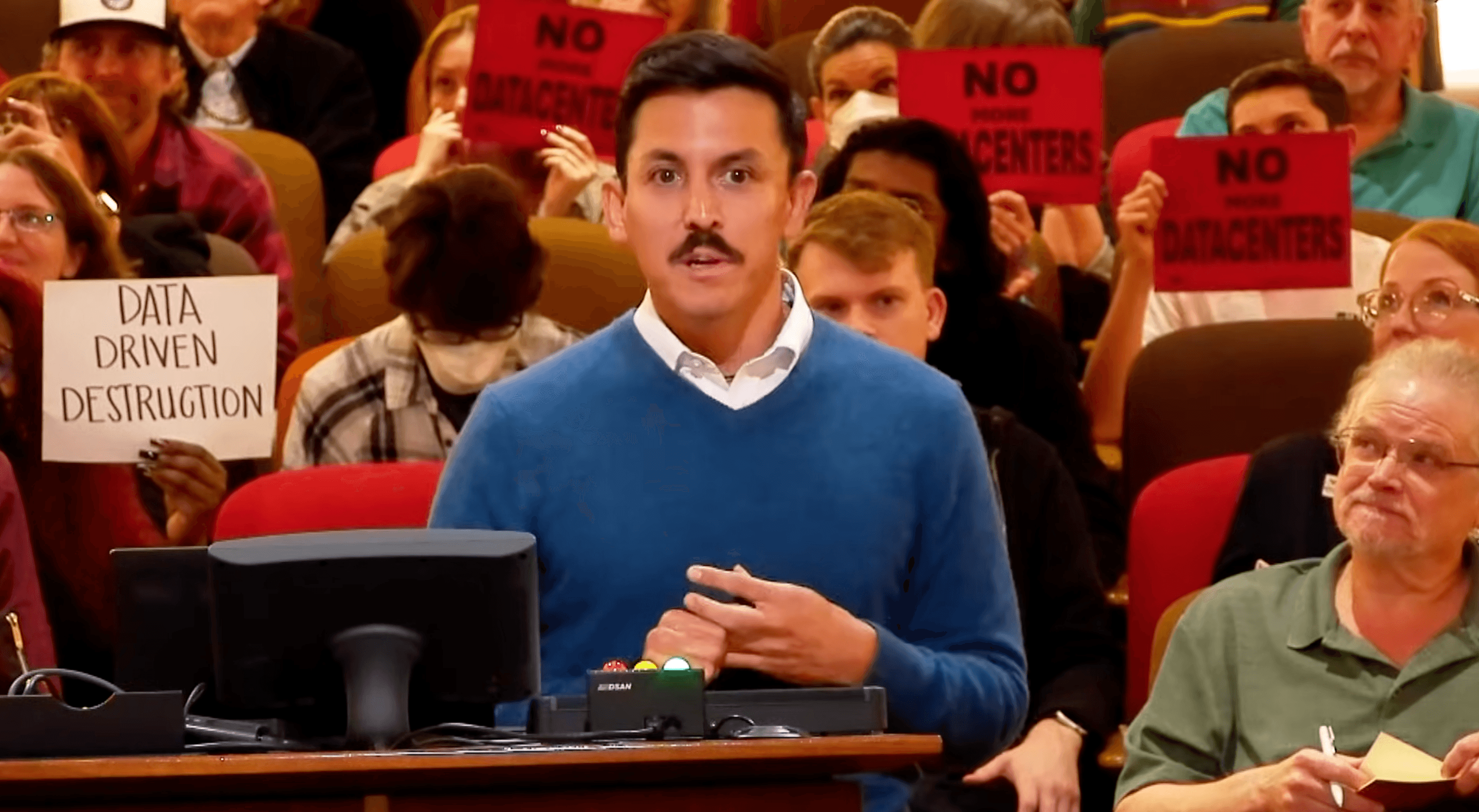
Until very recently, data centers were a politically neutral topic. Data center projects promised jobs, tax revenue, and community investment—a premise that made them politically popular amongst local politicians. Approvals could more easily move quickly through boards, readily accepted by policymakers. Some members of the community even came to meetings to speak in favor of projects.

In 2021, Loudoun County was celebrating "International Data Center Day". Source:
That norm has changed, however. Now, speaking in support of a data center can be a political death sentence.
As the number of planned data center facilities has risen to more than 4,000 [1], local opposition has grown stronger than ever. As of May 18, 2026 [2], seven in 10 Americans opposed the construction of data centers in their area, with nearly half strongly opposed. Fragmented individual complaints turned into structured opposition organizations. The result was politicians that once publicly approved of construction scrambling to regain favor from their constituents. Those who didn't were left at the mercy of the next, unhappy voting block. Meetings were crashed by vocal residents that demanded commissioners to step down. Projects began to be delayed or cancelled entirely, even after governments approved them.

A contentious hearing in Hermantown, MN had residents complaining about transparency and labor unions showing up to support job growth. Source
Virginia, a hotspot for data centers with nearly 750 operational and planned facilities [3], contains the clearest examples of this pattern. In Virginia, data centers are not just a political issue—they are the defining factor in local elections across the state. As data center projects have grown in Virginia, career politicians who once supported data centers were quickly ousted in favor of new candidates that centered their platforms on opposing the projects. For others, they were left with a choice—change your position, or get voted out.
# Case One: Prince William County
| Politician | Jurisdiction | Initial position | Trigger | Later position / outcome |
|---|---|---|---|---|
| Ann Wheeler (Former Board Chair) | Prince William County | Strong proponent of data centers, speaking publicly in support of large projects. | Wheeler approves the Prince William Digital Gateway project [4] | In a stunning upset, incumbent Board Chair Ann Wheeler is defeated by openly anti-data center candidate Deshundra Johnson in 2023 [5]. |
In September of 2022, Prince William County first approved the necessary rezoning for a data center project called Digital Gateway that would reserve more than 2,000 acres of land for development. Local politicians promoted the project as an opportunity for the county to receive investment and increased tax revenue. Led by County Chair Ann Wheeler, the Board continued to approve rezoning requests.
# "$40 billion in investment in this county ... would be transformational"..."Most places would kill for investment like that."
—Ann Wheeler, Former county chair [6]
However, in 2023, everything changed; the voting block of Virginia pivoted rapidly as concerns about the environmental impacts, noise, and demand of the project replaced the former appreciation for the project's economic benefits.

A protest against the Prince William Digital gateway data center in April of 2023—just two months before the county board primaries. Source: James Jarvis | InsideNoVa
At the same time, voters began to line up for the county's next election. The top issue on the ballot? Data centers.
By all means, Wheeler was the favorite for the election—she raised more than all three of her opponents combined and built a long career as a civic leader and on county boards [7]. But Wheeler had one repeated weakness in the eyes of voters: her support for data centers [8]. Wheeler remained steadfast in her support for the project, insisting that it was beneficial for the county. In stark contrast, her opponent Deshundra Johnson campaigned on a platform of opposition to the Digital Gateway project.
In the end, Ann Wheeler lost the Democratic primary in 2023 with a major factor being her opponents citing her support for the Digital Gateway project as a danger to constituents [9]. In 2026, the new County Supervisors voted to withdraw support for the data center project.
# Data Center Opposition becomes Bipartisan
# "I have told the data centers from the beginning, if they apply for rezonings in the rural area, it's dead on arrival for me"
—Janine Lawson, Republican Nominee for County Chair
At the same time, voters in the Republican primary also looked to data centers to cast their ballots. While there was no incumbent Republican to be ousted, Supervisor Jeanine Lawson beat opponent Ken Knarr in a landslide with more than 81 percent of the vote for the Republican nomination for county chair [10]. Right outside the polls, it became apparent that data centers were at the top of voters' minds; the reason that voters cited as decisive for their vote was Lawson's anti-data center position. Lawson was notably, and uniquely for a republican, outspokenly opposed to data center projects, and even called for an investigation of her colleague for alleged corrupt practices tied to data center approvals [11] [12].
It's not surprising that data centers find bipartisan opposition. Yet, to become the defining factor in elections on both sides of the aisle shows how influential it has become politically.
These elections happened in 2023 when 69% of Virginia's voters said they would be comfortable with local data centers projects—that number has since dropped to 35 percent [13]. While data centers used to take the backstage in local politics, they now determine the outcome—regardless of party lines—in many counties.
# Case Two: Loudoun County

Mentions of "Data Centers" in Loudoun County have steadily increased since 2021 as the asset class became more controversial.
In the 2010s, data centers in Loudoun were embraced as a vehicle for economic growth. The county's supervisors cited the tax revenue benefits that would go into county investment. Projects were frequently approved without the same opposition seen today.
However, fragmented opposition across the country became structured and effective through the beginning of 2023. Coalitions spoke at town hall meetings demanding an end to "Big Tech's" exploitation of county resources.
 "The
Public is being forced to pay for energy infrastructure while data
centers buy energy in bulk and get a discount." Source
"The
Public is being forced to pay for energy infrastructure while data
centers buy energy in bulk and get a discount." Source
In February of 2024, the Supervisors turned to a stricter position on the centers. They began with a comprehensive review of data center policies, looking to tighten once loose regulations. Then, they rejected data center after data center.
By March of 2025, the board of supervisors voted 7-2 to put all data center proposals to the test by passing the CPAM and ZOAM, marking an unprecedented, tightened regulatory framework in the county [14]. The amendments effectively required all data centers to obtain special approval—including a legislative review and multiple public hearings—in place of the ordinary "by-right" administrative approval process [15].
Loudoun's case shows the other side of the opposition's consequences—when pro-data center politicians aren't voted out, they pivot positions to regain support. What once was a narrative of economic growth for the county transformed into an appeal to residents who fear the consequences of large-scale projects. When constituents apply pressure, politicians fall in line.
Loudoun county is not an exception—it's one of the first counties in a line of others that will turn to harsher regulation. Loudoun's case is already being cited across the country as a model off which to operate the data center regulation process.
# The National Outlook
As community opposition to data centers has grown more organized, local politicians have fallen in line. More broadly, proposed benefits such as increased tax revenue have become less appealing to voters who instead increasingly mention factors such as noise, electricity demand, and environmental concerns with a negative sentiment.
On a national level, data centers may not sway large metropolitan elections now—but they will become increasingly important. In New York City, legislators are advancing a moratorium on AI-oriented data centers across the entire state [16]. Pennsylvania Governor Josh Shapiro—a 2028 presidential prospect—has become outspoken about regulating data centers as he relaunches his election campaign [17]. Representative Alexandra Occasio-Cortez made headlines after bringing polluted water from a Georgia Data center to a congressional hearing [18]. The isolated cases in Virginia forecast the newest trend in politics: 'Data centers,' 'Big Tech,' and 'AI' are words that will become central to the most important elections of the upcoming year.

*Alexandra Ocasio-Cortez holding a jar of polluted water from a data center in rural Georgia at a congressional hearing on the EPA's handling of data centers. *
# A Sign for Developers
The case of Prince William and Loudoun county are not isolated ones; data centers across the United States will be blocked in a similar manner as increasingly vehement anti-data center candidates win elections.
GatherGov exists to help real estate professionals navigate the complexities of municipal entitlement. We track risk signals from more than 7200 jurisdictions—public-comment sentiment, council voting patterns, existing development pipeline—helping teams manage site selection, entitlement flows, and community engagement plans. You can read more about opposition to hyperscalers here.
If you want more analyses like this one, subscribe to the GatherGov newsletter. One piece a week, focused on the political and regulatory signals that don't show up anywhere.
# Footnotes
-
Fitzpatrick, Alex. "America’s Data Center Growth Hot Spots, Mapped." Axios, 18 Dec. 2025. https://www.axios.com/2025/12/18/data-center-growth-map-states ↩
-
Jones, Jeffrey M. "Americans Oppose AI Data Centers in Their Area." Gallup, 13 May 2026. https://news.gallup.com/poll/709772/americans-oppose-data-centers-area.aspx ↩
-
"Virginia Data Centers – Colocation and Cloud." DataCenterMap. https://www.datacentermap.com/usa/virginia/ ↩
-
Carey, Julie, and Matthew Barakat. "Prince William County Voters Back Data Center Opponents in Primary." NBC4 Washington, 22 June 2023. Accessed 18 June 2026. https://www.nbcwashington.com/news/politics/decision-2023/prince-william-county-voters-back-data-center-opponents-in-primary/3372105/ ↩
-
Marcilla, Max. "Prince William County’s Chair Defeated in Primary, Highlighting Role of Data Centers in Area’s Politics." DC News Now, 23 June 2023. Accessed 18 June 2026. https://www.dcnewsnow.com/news/local-news/virginia/prince-william-county/prince-william-countys-chair-defeated-in-primary-highlighting-role-of-data-centers-in-areas-politics/ ↩
-
Barthel, Margaret, and Tyrone Turner. "Controversial Data Center Plan Passes in Prince William County after 27-Hour Hearing." DCist, 13 Dec. 2023. https://dcist.com/story/23/12/13/prince-william-board-of-county-supervisors-approve-digital-gateway-plan/ ↩
-
Sczerzenie, Anya. "Board of Supervisors Chair Ann Wheeler Outraises Her 3 Opponents with Help from Unions, Data Center Interests." Prince William Times, 5 May 2023. Accessed 18 June 2026. https://www.princewilliamtimes.com/news/board-of-supervisors-chair-ann-wheeler-outraises-her-3-opponents-with-help-from-unions-data/article_bb05f8f0-eb66-11ed-ba99-1be8fd32166d.html ↩
-
"Supervisors, Activists Split on Prince William County Board Chair Ann Wheeler’s Primary Election Loss." Prince William Times, 28 June 2023. Accessed 18 June 2026. https://www.princewilliamtimes.com/news/supervisors-activists-split-on-prince-william-county-board-chair-ann-wheeler-s-primary-election-loss/article_d51537d4-15f4-11ee-8bd6-27408d6a0cae.html ↩
-
Olivo, Antonio. "Data Center Backlash Fuels Prince William Board Chair’s Election Loss." The Washington Post, 21 June 2023. Accessed 18 June 2026. https://www.washingtonpost.com/dc-md-va/2023/06/21/ann-wheeler-data-centers-election/ ↩
-
Sheehan, Karen. "Prince William Times: UPDATED: Lawson Supporters Cite Data Center Concerns in GOP Primary for County Chair." The Coalition to Protect Prince William County, 22 June 2023. Accessed 18 June 2026. https://protectpwc.org/2023/06/22/prince-william-times-updated-lawson-supporters-cite-data-center-concerns-in-gop-primary-for-county-chair/ ↩
-
Flores, Christian. "Republican Candidates Eye Taxes, Data Centers in Fight for Prince William County Chair." WJLA, 15 June 2023. Accessed 18 June 2026. https://wjla.com/news/local/prince-william-county-board-chair-republican-candidates-taxes-data-centers-meals-tax-food-beverage-reduction-jeanie-lawson-kenn-karr-digital-gateway-project ↩
-
Palermo, Jill. "Supervisor Jeanine Lawson Calls for Former Supervisor to Be Investigated for Corruption Tied to Data Centers." Prince William Times, 20 Sept. 2023. Accessed 18 June 2026. https://www.princewilliamtimes.com/news/supervisor-jeanine-lawson-calls-for-investigation-of-former-supervisor-for-corruption-tied-to-data-centers/article_1487c65e-5757-11ee-b00d-33ba98c35664.html ↩
-
Halper, Evan, et al. "In This U.S. Hot Spot for Data Centers, Voters Have Turned against Them." The Washington Post, 15 Apr. 2026. https://www.washingtonpost.com/business/2026/04/15/data-centers-poll-virginia/ ↩
-
"Data Center Standards & Locations | Loudoun County, VA – Official Website." Loudoun.gov, 2024. https://www.loudoun.gov/5990/Data-Center-Standards-Locations ↩
-
Schneider, David, and Briana Stolley. "Loudoun County, Virginia, Eliminates By-Right Data Center Development." Holland & Knight, 2025. https://www.hklaw.com/en/insights/publications/2025/04/loudoun-county-virginia-eliminates-by-right-data-center-development ↩
-
Gladstone, Seth. "NY Gov. Hochul Must Sign One-Year AI Data Center Moratorium Passed by Legislature." Food & Water Watch, 4 June 2026. Accessed 19 June 2026. https://www.foodandwaterwatch.org/2026/06/04/ny-gov-hochul-must-sign-one-year-ai-data-center-moratorium-passed-by-legislature/ ↩
-
Behr, Peter. "Shapiro Tests Democrats’ Data Center Strategy." E&E News by POLITICO, 19 Feb. 2026. https://www.eenews.net/articles/shapiro-tests-democrats-data-center-strategy/ ↩
-
Bynum, Zachary. "AOC Presses EPA over Morgan County Drinking Water Concerns Tied to Georgia Data Center Development." CBS News, 25 May 2026. https://www.cbsnews.com/atlanta/news/aoc-presses-epa-over-morgan-county-drinking-water-concerns-tied-to-georgia-data-center-development/ ↩