These days if a local government has a contentious public hearing, they are more often than not talking about data centers. And if they are talking about data centers, they are almost always talking about the big three tech firms that dominate the industry. We analyzed 3,332 mentions of Google, Amazon, and Meta data centers in local government meetings across 46 states since March 2026 to understand the shape of this public opposition.
What we see is a growing list of organized community groups that are working to limit the growth of data centers in their city and counties. Most of these groups have similar concerns backed by the same set of case studies and precedents. The fears motivating these groups are real. But the stories that they cite change in transit.
# 3,332 mentions, one lopsided verdict
It would suprise no one to know that across the full dataset, 54% of big tech hyperscaler mentions are negative, against 37% neutral and 9% positive. However, when we break down sentiment by speaker type, an interesting pattern appears.
Members of the public who step up to comment are 77% negative. However the officials running the meetings are 66% neutral, and only 24% negative. That is a 53-point gap between the podium and the dais.
While most public commentators are concerned residents, there is a growing list of organized community groups who show up consistently to protest against the data centers. Among them are national organizations like Honor the Earth, whose Tulsa chapter appears multiple times in public meetings to oppose Meta's Project Anthem. Others like For the People Alliance, a resident group in Harlingen, TX, are more local and specific, whose purpose is to solely challenge data center growth in their city.
Yet, despite the difference between these organizations, their concerns read similar.
 The volume on the public-comment side is not spontaneous. It is organized and the most active coalitions cluster around specific companies and specific places.
# It's not pro vs. anti. It's jobs vs. water and energy.
When we sort the negative mentions by the main concerns stated, the leading are rates and energy (729 mentions), infrastructure (680), and water (560).
By comparison, where a mention is positive, it is almost always about jobs (77), infrastructure investment (74), or tax revenue (53). Interestingly, even in the current climate, there are still places where the economic case wins out and conversation is positive about data centers. Bossier Parish, Louisiana ran 23 positive mentions to zero negative as council members praised the track record of a Amazon facility operating across the river—500 construction jobs and 270 permanent ones.[1] In Seguin, Texas, council members logged 53 mentions without a single negative one, focusing on tax-base benefits of Meta's data center.[2]
The economic framing tends to win in the Gulf South and parts of the Plains. However, it fails in the water-anxious Southwest and the precedent-saturated Midwest. El Paso, Texas at 99%, Hobart, Indiana at 94%, and Sedgwick County, Kansas at 96% all are overwhelmingly negative, with water as their primary concern.
 The discussion is national with different companies anchoring different corners of the map.
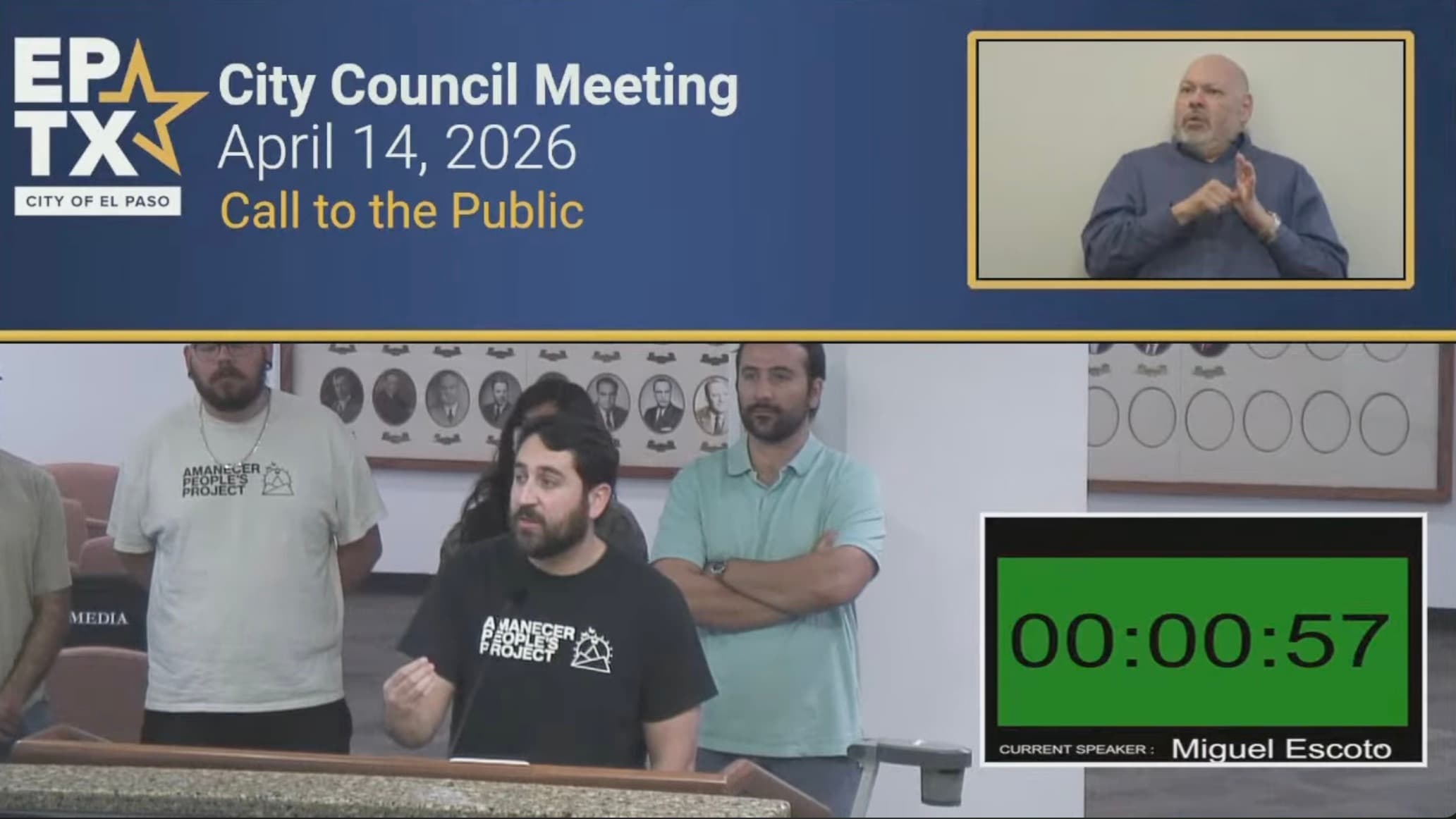
El Paso is the largest of these fights, where a Meta data center is raising resident concerns about water. The opposition there is organized and bilingual. Sembrando Esperanza Coalition and Amanecer People's Project, both operating in the city, are the two most frequently appearing organizations anywhere in our data. Official concerns also follow along resident lines—El Paso Water has warned that large industrial users could significantly raise demand and cause water stress in a city that has little to spare. [3]
But not every fight is about water or power bills. In Hermantown, Minnesota, Google's data center plan is running into public anger about process. A community group called "Stop The Hermantown Data Center" has appeared at least 7 times in the last 3 months, demanding answers. Residents say the city quietly amended its zoning to let a heavy-industrial facility qualify as "light industrial," never disclosed that the project was a Google data center, and bound the process in non-disclosure agreements that only surfaced through public-records requests.[4]
With debate still ongoing in both cities, what happens in El Paso and Hermantown will be key to understanding how the hyperscaler buildout will continue.
 A contentious hearing in Hermantown, MN had residents complaining about transparency and labor unions showing up to support job growth.
# The case study that grows in the telling
The most interesting story among the hyperscalers is of Amazon's. Out of the three companies, Amazon's mentions run the most negative (56%) and carry the heaviest concentration of pollution, health, and water concerns. But most of the time when people are talking about Amazon data centers, they are rarely talking about the one being built in their city. Rather they are talking about the one it built in Morrow County, OR in 2011.
In March 2026, Amazon agreed to pay $20.5 million to settle a groundwater contamination suit in Morrow County with no admission of guilt, as one of 17 defendants named in the case. According to the Oregon Capital Chronicle, the nitrate pollution there is decades old and has many sources—wastewater from the Port of Morrow, industrial food processors, area agriculture, and the data centers, whose cooling process concentrates nitrate already present in the water. The groundwater contamination was flagged by the state of Oregon as far back at 1990 [5], decades before the first data center opened in the county.
Amazon was the first defendant to settle, 16 of the other defendants are all still being litigated. The cancer and miscarriage link is real as a community fear, but unproven as causation. No official public health study has yet been done, and reporting around it repeat community members' fears that their illnesses may have been caused by nitrate contamination.
 Morrow County, OR's nitrate contamination dates as far back as 1990s, and is tied to 16 other defendants . Yet in public meetings across the nation, the story is only about an Amazon data center built in 2011.
This is the most repeated case study by opposition public commentators. But like a game of telephone, the same story changes into many different versions as it gets repeated in councils across America.
In Arlington, Washington, a resident tells the story as so. Amazon opened the county's first data center in 2011, a county commissioner tested seventy wells, and sixty-eight came back over the federal nitrate limit.[6] Accurate, but with no mention of the other 16 defendants.
By Sedgwick County, Kansas, the health fears has hardened into fact—the nitrates "actually caused rare cancers and miscarriages."[7] In Harford County, Maryland, the facility has shrunk to an oddly specific "10,000 square foot" building and gained "birth defects" as an additional harm.[8] And before a Michigan House committee, the story has acquired PFAS, heavy metals, and a statistic that appears nowhere in the reporting. Amazon's data center caused "a 46% increase in rare cancers."[9]
The settlement itself gets read two opposite ways. In Swain County, North Carolina, a speaker argues that Amazon's willingness to pay proves it knew a trial would cost far more.[10] In Sunbury, Ohio, another tells the council Amazon "lost" a lawsuit because plaintiffs "could prove" the contamination.[11]
Whats interesting is the difference in the way the case is being talked about in Oregon vs outside the state. Hermiston, Oregon is right next to Morrow County but their March council meeting featured no mention of cancers at all. A councillor calmly discussed adding a public safety impact fee to Amazon's contracts and worried that the state's data center moratorium was creating economic uncertainty that would push investment elsewhere.[12] The difference is very stark—the place that lives right next to ground zero is negotiating fees; a resident 2,800 miles away is asking whether the council is "okay with your neighbors' babies dying."
This isn't to undermine the worries and concerns of people. The well data is real, and nitrate contamination is an incredibly serious public health concern. But the drift in the story to the point of misinformation is worth talking about. The residents of Morrow County are still fighting for accountability from the other 16 defendants who never come up in the meetings. Only Amazon, the one that already paid (and the one that makes for sensational headlines) does.
# Real fears, travelling facts
The opposition to hyperscalers is real, organized, and growing. The concerns driving it, about water, power, and process, are legitimate ones that deserve real answers.
But the evidence those concerns travel on gets less reliable with every retelling. A single Oregon settlement becomes, three states away, a 46% spike in cancer.
That should concern everyone in the room. Residents deserve to make their case on what actually happened, not on a version that has drifted toward the sensational. Officials are being asked to weigh major investments against claims that don't always hold up. And the companies end up answering not for their own record but for the industry's worst-told story, recited back to them in a town that has never seen one of their facilities.
The buildout is not slowing down, and neither is the opposition to it. What happens in places like El Paso and Hermantown—and how accurately the cases that travel between them get told—will shape where the next wave of data centers can actually get built. For now, the surest thing we can say is that the loudest version of a story is rarely the most accurate one.
Source: GatherGov analysis of 3,332 data center mentions across 46 states, March–May 2026. Meeting citations below link to the original public recordings. Analysis of sentiment and project details is done through the platform's pattern extraction tool. The data used in this analysis can be provided upon request.
# Footnotes
-
Bossier Parish, LA — Police Jury, March 18, 2026. https://www.facebook.com/100064785606606/videos/914640591492001 ↩
-
Seguin, TX — City Council, May 5, 2026. https://cityofseguintx.granicus.com/player/clip/384?view_id=2&redirect=true ↩
-
El Paso, TX — Commissioners Court, March 19, 2026. https://www.youtube.com/watch?v=tnQzlC9u1QU ↩
-
Hermantown, MN — City Council, March 16, 2026. https://www.youtube.com/watch?v=itEKX5cdZI0 ↩
-
Alex Baumhardt, "Amazon to pay $20.5 million settlement over northeast Oregon nitrate pollution," Oregon Capital Chronicle, March 31, 2026. https://oregoncapitalchronicle.com/2026/03/31/amazon-to-pay-20-5-million-settlement-over-northeast-oregon-nitrate-pollution/ ↩
-
Arlington, WA — City Council, May 18, 2026. https://www.youtube.com/watch?v=yIE3Xq7KwrE ↩
-
Sedgwick County, KS — Board of Commissioners, March 4, 2026. https://www.facebook.com/sedgwickcounty/videos/4555122588051202/ ↩
-
Harford County, MD — Council, April 14, 2026. https://harfordcountymd.new.swagit.com/videos/382181 ↩
-
Michigan House of Representatives — committee hearing, April 22, 2026. https://www.house.mi.gov/VideoArchivePlayer?video=CORP-042226.mp4 ↩
-
Swain County, NC — Board of Commissioners, April 21, 2026. https://www.youtube.com/watch?v=5vNvqofZRv0 ↩
-
Sunbury, OH — City Council, April 15, 2026. https://www.youtube.com/watch?v=9oFaB9apEOs ↩
-
Hermiston, OR — City Council, March 9, 2026. https://www.youtube.com/watch?v=ar2lejqubS8 ↩