
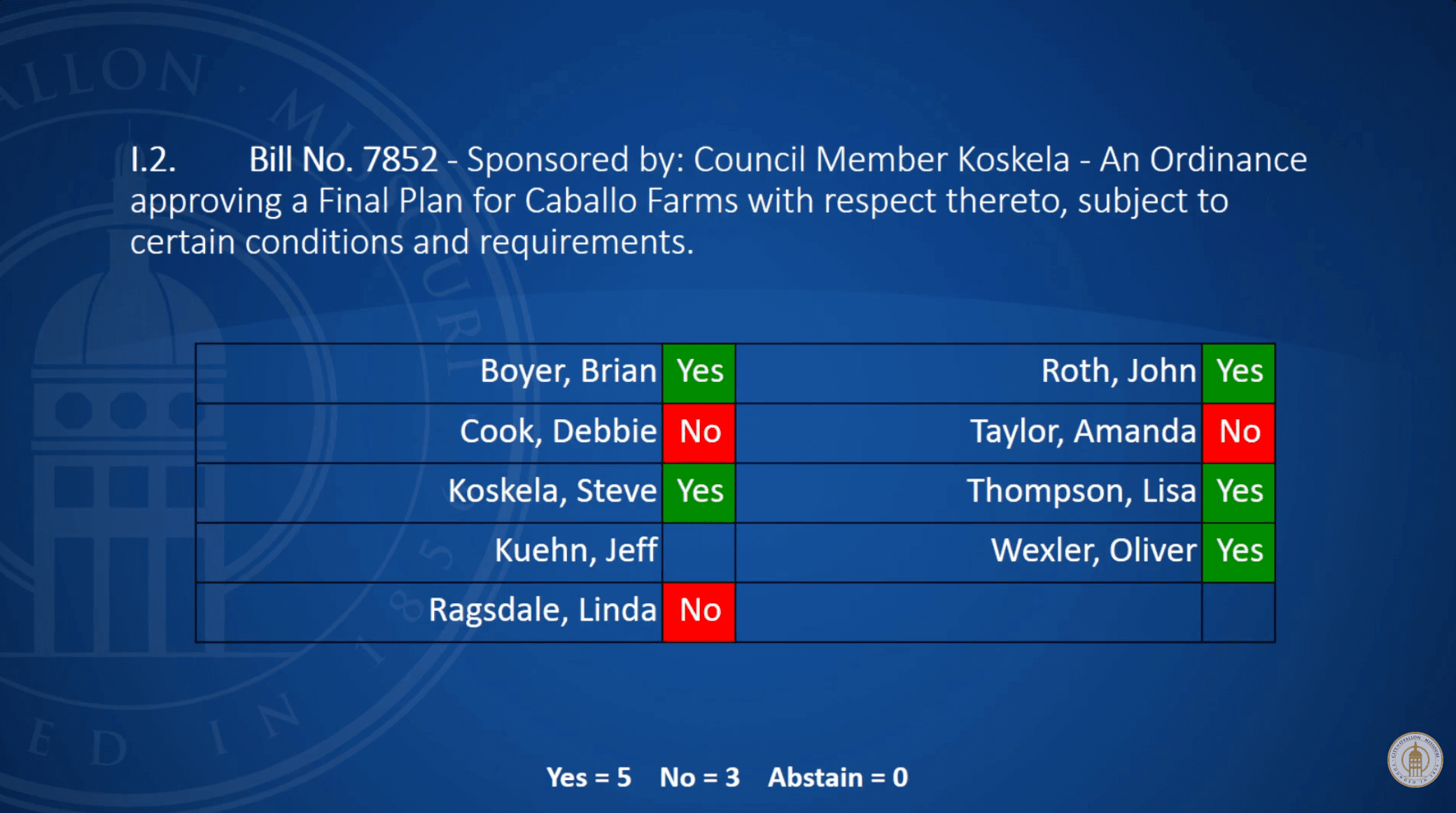
On April 23, 2026, the O'Fallon, MO city council took a vote on the final development plan for Caballo Farms, a 276-home, single-family subdivision on 94 acres of newly annexed land.[1] The final tally was 5-3, just shy of the 6-vote majority required to pass the project.
Councils reject projects all the time, but this vote was different. The council might not legally have the authority to block this project. As City Attorney Stephanie Karr explained during the vote, the council had already approved the initial plan and rezoning. This was the confirmation of the final plan. As long as the specifications of the project matched the requirements of the zoning code—which it did—Council was legally required to pass it.[2]
The members who voted no seemed confused. "Can't we send it back to P&Z?" Councillor Amanda Taylor asked. Her concern was with the small lot sizes and increased stress on traffic and city finances. Attorney Karr responded—the time to do that was during the initial approval. Now it might be too late.[2]
But the council members didn't move their position. And when the motion failed, Mayor Bill Hennessy summarized the mood: "So that's right, good luck in court folks."[2]
O'Fallon council will need their luck. A week later, the developer, McBride Homes, filed suit in St. Charles County Circuit Court asking a judge to order the council to approve their project.[3] A lengthy legal battle between Missouri's largest home developer and the city is now imminent. But how did we get here?
# What happened on April 23
| Date | Body | Action | Outcome |
|---|---|---|---|
| Jan 22, 2026 | Council Workshop | Concept preview | No vote |
| Feb 5, 2026 | P&Z Commission | Annexation + rezoning | Recommended |
| Feb 26, 2026 | City Council | Annexation + R-1 PUD | Approved (6-3)[4] |
| Apr 2, 2026 | P&Z Commission | Final plan | Recommended (unanimous) |
| Apr 23, 2026 | City Council | Final plan | FAILED (5-3, 1 absent) |
| May 7, 2026 | Circuit Court | Mandamus petition filed | Pending |
Caballo Farms didn't pass for one simple reason—it lost its votes. Between when the project first appeared in O'Fallon transcripts in January and the final vote in April, the same members voted for and against it. But during the final vote, one of Caballo Farms' supporters, Council Member Jeff Kuehn, was missing. He was voted out of office on April 7 and was working out of town during the April 23rd hearing.[5]
Council members Linda Ragsdale and Lisa Thompson were also voted out of office. They, however, showed up for their final meeting.
The shadow of the election loomed large over the April 23 meeting. The start of the meeting included a heartfelt speech from the outgoing council members. Council Member Amanda Taylor, who is continuing on the council, talked about renewed focus. She also talked about the election result being a mandate from the voters: be responsible with how growth affects city resources.[2]
 O'Fallon City Council meeting, April 23, 2026: https://youtu.be/_gX77gYenRY?t=3356
Caballo Farms, though it meets all the ordinances required as a Planned Unit Development, does impact the city. And the voters know that. One of the public commentators who spoke during the meeting was Arnie "C" Dienoff, a candidate for upcoming county elections. He was clear with his request:
"I'd ask that you defeat the final plan and Caballo Farms. We will be losing $0.33 on every dollar of income from real estate, personal property tax, utility taxes and sales taxes. We need to pay for city services, and we need to at least break even."[2]
So the political winds have turned against this project. But McBride isn't willing to sit back.
# Why McBride said enough
It's understandable why the developer of Caballo Farms would be frustrated. But taking a city to court is an extreme—and extremely expensive—action. McBride Homes believes that they have a good case. And they have a reputation to protect.
As the largest homebuilder in Missouri, McBride has been building in metro St. Louis since 1946.[6] Caballo Farms isn't even its first project in O'Fallon—it sits adjacent to Harvest, another McBride community already under construction.[1] Homes in Caballo Farms were already sold to potential buyers, some of whom had taken mortgages to finance them.[7]
Relitigating the lot sizes (as the dissenting councilors wanted) would bring into question every sales contract and procurement decision already made. When you operate at McBride's scale, you can't eat a denial like this without challenging it.
# Yes, developers can sue cities. And they do.
What McBride has filed with the court is a request for a writ of mandamus, a court order directing a government body to perform a specific act it is legally required to perform. It's a recognized remedy in Missouri under Supreme Court Rule 94 and has been used in land-use disputes for decades.[8]
When a plat or final plan complies with the zoning and subdivision requirements, the commission and council have no discretion to deny it.[9] What the council can do is decide whether the application conforms. What it cannot do is decide, after conformance is established, that it just doesn't like the project anymore.
McBride's complaint is based on this precedent. The argument is that the final plan substantially conformed to the previously approved area plan and that the council therefore had no discretion to deny. The complaint also seeks declaratory and injunctive relief plus damages and attorneys' fees.[3]
# What is the precedent?
 Legal precedent in Missouri doesn't look good for the O'Fallon City Council
The closest precedent to Caballo Farms in Missouri is Furlong Companies, Inc. v. City of Kansas City, decided by the Missouri Supreme Court in 2006.[10]
- A developer submitted a preliminary plat that conformed to Kansas City's subdivision ordinance.
- The city's own legal counsel attended a closed session and advised the council that there was no legal basis to reject it.[10]
- The council voted to deny anyway, 9 to 4, without issuing findings of fact or conclusions of law.
- The developer filed suit five days later seeking mandamus and damages.
- The trial court granted mandamus, ordering Kansas City to approve the plat.
- The trial court also awarded $224,871 in actual damages and $148,435.20 in attorney's fees against the city under 42 U.S.C. § 1983.
- The Missouri Supreme Court affirmed the judgment as modified.[10]
For Caballo Farms, the record on compliance is unusually clean. The project had passed unanimously through Planning and Zoning, and even the city attorney questioned the legitimacy of the vote on the record. This is a hard case for the city to win.
Damages are a separate question. If McBride pursues a § 1983 claim alongside mandamus and prevails, the city's exposure also includes carrying costs on the land, lost margin on the 276 homes, and McBride's attorney's fees.
# The takeaway
The political signals that produced the 5-3 vote on April 23 were not invisible in February. In fact, our municipality report identified them before the April vote.
Council comments, public testimony, and the campaign rhetoric leading into the April 7 election had plenty of signals that something was going to change. The developers who avoid getting caught in a Caballo Farms situation are the ones tracking those signals before the first ordinance reading. GatherGov exists to surface those signals— across thousands of municipalities, in real time.
# FAQ
Can an O'Fallon, MO city council legally deny a final plan that complies with the approved area plan?
Under Missouri law, when a final plan substantially conforms to the previously approved area plan, code, and any conditions imposed during rezoning, the council's approval is generally treated as a ministerial act rather than a discretionary one. A council that denies on that record exposes itself to a writ of mandamus.
What is a writ of mandamus in real estate?
A writ of mandamus is a court order directing a government body to perform a specific act the law requires it to perform. In land use, developers use mandamus to compel approval of plats, final plans, or permits when the approving body had no legal discretion to deny.
How often do developers actually sue cities over zoning and final-plan denials?
There are no national statistics tracked centrally, but developer-vs-city land-use suits are common enough that most state appellate courts hear several a year. The realistic question is rarely whether the suit will be filed — it's whether the developer wants the litigation cost and timeline given the stakes on the specific project.
What happens if McBride Homes wins the Caballo Farms lawsuit?
If the court issues mandamus, the O'Fallon city council is directed to approve the Caballo Farms final plan and the project moves forward. If McBride also prevails on a § 1983 claim, the city is liable for damages and attorney's fees. The closest Missouri precedent, Furlong Companies v. City of Kansas City, produced a combined damages and fees award of roughly $373,000.
Why did O'Fallon's city attorney advise against denying Caballo Farms?
According to McBride's filing, city attorney Stephanie Karr advised the council that the final plan conformed to the approved area plan and the city's zoning code, and that there was no legal basis to deny. When a city's own counsel makes that record before a vote, it strengthens the developer's case substantially if litigation follows.
Is the Caballo Farms denial related to the April 7, 2026 O'Fallon election?
There is no direct evidence linking the two, but the timing is notable. Three council incumbents lost their seats on April 7. The final-plan vote came sixteen days later. The political environment around the project shifted between the February approval of zoning and the April denial of the final plan.
# Footnotes
-
KSDK, "McBride Homes sues O'Fallon after City Council rejection of subdivision plan," May 7, 2026. https://www.ksdk.com/article/news/local/mcbride-homes-sues-ofallon-after-subdivision-plan-rejected/63-a2a86ca5-67b5-497d-b39e-b4fa089944c2 ↩ ↩[2]
-
O'Fallon City Council meeting, April 23, 2026, video record. https://youtu.be/_gX77gYenRY ↩ ↩[2] ↩[3] ↩[4] ↩[5]
-
First Alert 4, "McBride Homes sues O'Fallon, Mo. over Caballo Farms development plan," May 7, 2026. https://www.firstalert4.com/2026/05/07/mcbride-homes-sues-ofallon-mo-over-caballo-farms-development-plan/ ↩ ↩[2]
-
Mid Rivers Newsmagazine, "Caballo Farms development, related annexations approved," March 2026. https://www.midriversnewsmagazine.com/news/caballo-farms-development-related-annexations-approved/article_713a3bec-4d8d-4f46-b30f-e2bf8b34fd90.html ↩
-
First Alert 4, "Municipal races around Missouri saw small margins, ties," April 8, 2026. https://www.firstalert4.com/2026/04/08/municipal-races-around-missouri-saw-small-margins-ties/ ↩
-
McBride Homes corporate website. https://mcbridehomes.com/ ↩
-
First Alert 4, May 7, 2026 (see note 2). Mayor Hennessy's no-comment posture and city attorney Stephanie Karr's advice to the council are both sourced here. ↩
-
Missouri Supreme Court Rule 94, governing mandamus practice. https://www.courts.mo.gov/page.jsp?id=199924 ↩
-
State ex rel. Schaefer v. Cleveland, 847 S.W.2d 867, 873 (Mo. App. 1993), establishing that approval of a plat meeting subdivision and zoning requirements is a ministerial act. ↩
-
Furlong Companies, Inc. v. City of Kansas City, 189 S.W.3d 157 (Mo. banc 2006). https://caselaw.findlaw.com/mo-supreme-court/1387447.html ↩ ↩[2] ↩[3]