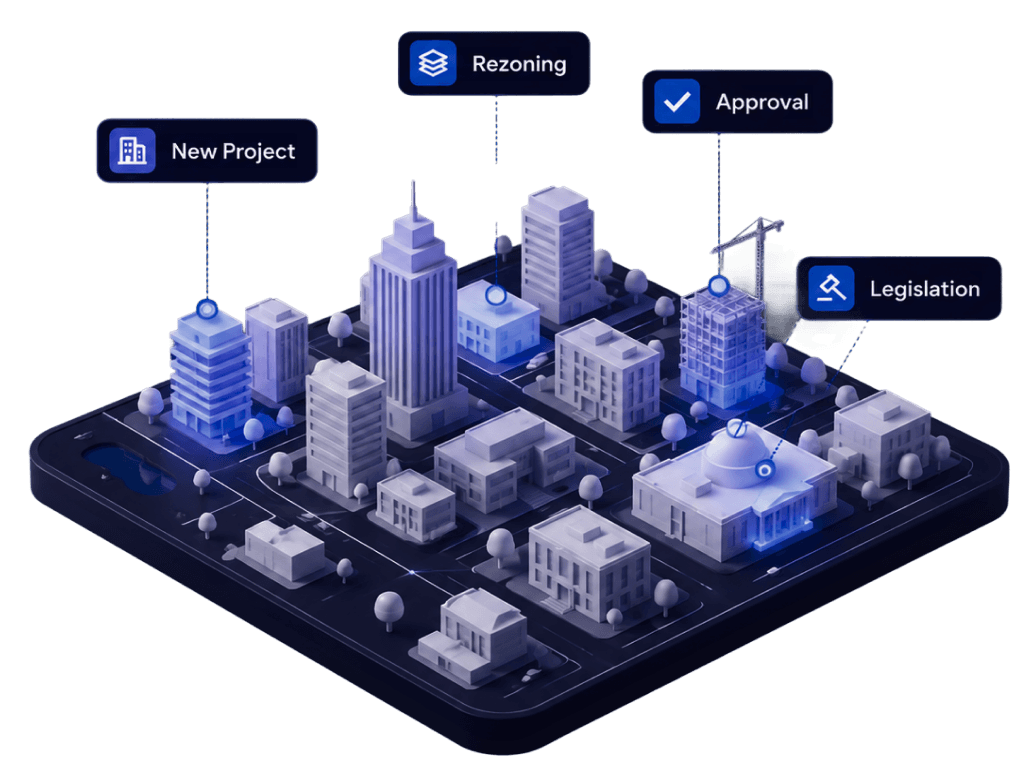
Development News for Lynnwood, Washington
GatherGov Agents listens to meetings 24/7 delivering the latest real estate development updates, legislation, and news.
Development News from the latest meeting
Council Declines to Pursue Commemorative Flag Ordinance Amidst Budget Concerns and Higher Priorities
Council Member Mata proposed an ordinance for raising commemorative flags in public parks. The Mayor's current policy prohibits this. Council members provided feedback, largely indicating that this is not the right time for such an ordinance due to budget constraints and other higher priorities. Council Vice President Escamia stated that while not in disagreement, the city is facing many demands requiring time and money, and this is not a priority for 2026, suggesting it could be considered later. Councilmember Owings agreed, emphasizing that fixing potholes and addressing budget impacts are higher priorities. Councilmember Parshall agreed it's not the right time, especially given the budget year and lack of staff resources. Councilmember Wright suggested exploring the flag ordinance as part of the budget process if a cost estimate is developed, but also agreed it's not a priority for this year. Councilmember Mata acknowledged the feedback and decided not to pursue the ordinance further due to the current priorities and resource limitations. Council President Coelho noted that four banners are currently displayed near 44th and 196th, advertising the Pride event and featuring a Pride flag, which were put up by the city to increase visibility.
Workforce Task Group Reviewing CWA and PLA Templates, Planning Stakeholder Engagement for Mid-July Update
The Workforce Task Group, comprising Council Vice President Escamia, Councilmember Wright, and Councilmember Owings, has developed a loose plan. Their next steps involve meeting with all stakeholders, including contractors and labor unions, to discuss community workforce agreements (CWAs) or project labor agreements (PLAs). They are reviewing Seattle's CWAs and Everett's PLAs as templates. Councilmember Wright is focusing on procurement, contracts, and safety, reviewing Linwood's procurement documents and requesting templates. She has also reviewed past RFPs and contracts. The group plans to mark up existing templates to align with Linwood's needs and then engage with stakeholders such as various unions (Carpenters, Electrical), the AGC, and the Master Builders Association, followed by consultations with city staff. They aim to present a more robust update in mid-July. The task group is currently working internally to define their direction before involving city resources or staff.
Parks Department Faces Severe Budget Cuts, Jenga-Like Structure Raises Concerns for Service Levels and Staff Burnout
The Parks, Recreation, and Cultural Arts Department presented its budget reductions, which have made the department's structure "wobbly" like a Jenga tower, with a fear of collapse. The adopted budget was $21,847,918. Reductions include eliminating 5.75 FTEs in 2025 and freezing positions like park planner and park maintenance worker. The department reduced operating hours, eliminated recreation and open swims, pool rentals, and holiday hours. Family programming, including dances and the Halloween event, was eliminated. Part-time staffing hours were significantly reduced, accounting for another eight FTEs, impacting program delivery. For 2026, the customer service manager position will not be refilled, and an additional 0.75 FTE in part-time staffing was cut, affecting weight room hours. Vehicle sale proceeds are being used to offset reductions, impacting future replacement costs. The volunteer recognition dinner was eliminated (funded by a partner), and ASL interpretation for Shakespeare in the Park was cut (funded by another partner). There is no money for community collaborator grants, and human services money was swept, impacting support for cold weather shelters and hygiene supplies. Vandalism repair times are longer, GMAX texting and athletic complex grooming are reduced, playground inspections and interurban trail mowing are decreased, and irrigation and welcome sign maintenance are slowed. Funds for engineered wood fiber for fall protection are gone, and parking lot seal coating and tree care are not funded. Reductions also affect offsetting costs of projects and grants, which is not sustainable. Human services funding was swept, impacting support for emergency housing, opioid treatment, and rental assistance. Staff workload and morale are critically impacted, leading to a reduced level of service, potential burnout, and a shift from proactive to reactionary management. Vandalized amenities take longer to fix, such as a park bathroom closed for three weeks. Customer service is slower due to fewer part-time staff. Demand for park shelters is increasing due to economic tightening, but staffing shortages mean some requests cannot be met, leading to lost revenue. There is no redundancy in operations, and staff unavailability immediately backs up work. Planning processes are slowed but will eventually be rushed due to deadlines. Funding for collaboration grants for events is eliminated. There is no capacity for innovation or new ideas. Staff development, including travel and training, has been canceled. Unexpected increases in insurance ($177,000) and utility costs ($65,800 in Q1) are further straining the budget, totaling $242,000 in Q1 alone. Fee increases of 20% are offsetting lost programs but revenue is slightly declining monthly. Future needs include rebuilding capacity for new park projects and streetscapes. Direct service to customers, a departmental pride point, is at risk.
Police Department Faces Critical Staffing Shortages and Increased Overtime Due to Budget Cuts, Impacting Service Levels and Officer Well-being
The Police Department presented its budget situation, highlighting that an approved staffing allocation of 131 employees (80 commissioned, 48 non-commissioned) for the 2025-2026 biennium was impacted by $2.54 million in vacancy savings, translating to eight unfunded police officer positions. The department faced a 10% reduction request, which was not viable without cutting over 16 police officer positions. Savings were achieved through fleet extension ($1.1 million, one-time), salary savings from vacant positions ($900,000), reduced training costs ($420,000), and transfer of traffic safety fee revenue ($925,000). However, overtime costs have consumed salary savings. Current staffing is down due to unfilled clerk and records program technician positions, impacting public disclosure requests and body camera footage management. This forces supervisors and sergeants to work overtime. The front lobby had to be shut down due to clerk shortages, requiring officers to respond to community member inquiries. Crime prevention specialist positions (1.5 FTE) were repurposed as an executive assistant and volunteer coordinator. The three Custody Officer positions are nearing hire, but five are in training, and several others are on leave, resulting in only 18 officers available for shifts, leading to mandatory overtime and potential officer departure to other agencies offering better incentives. Minimum staffing levels are strained, decreasing patrol and specialized unit staffing, and increasing calls for service per officer. Animal control services are significantly reduced, with officers only handling safety-related calls, not found dogs or barking complaints. Public disclosure requests pose a liability risk due to strict timelines and reduced staff. Court mandates for case submission are challenging with limited staff. Calls for service are trending above last year (12.3% increase), with a high volume of shoplift, assault, and animal control calls. Overtime expenditures are a concern, though the department was under budget in 2025 due to salary savings and jail food cost reductions. The department operates in a zero-fail environment, facing significant trauma that has led to five officer disabilities for PTSD in the last four years. Mental health support is being enhanced, but staffing levels limit staff participation. Linwood's police department handles significantly more calls for service (30% more) than nearby peer agencies like Lake Stevens and Edmonds due to its status as a commercial hub and higher daytime population. With 72 funded positions, Linwood officers respond to calls comparable to Everett, which has more commissioned officers. Retention is a major challenge, with high costs to replace officers. A returning officer highlights the department's supportive culture. The department is exploring options for animal control, including potential non-police roles, in coordination with the union and LNI. The public safety sales tax is a future discussion point.
CNU Conference Highlights 'Gentle Density,' Suburban Retrofitting, and Overcoming Imagination Barriers for Better City Development
Council President Coelho and Councilmember Wright attended the Congress for the New Urbanism (CNU) conference in Northwest Arkansas. The CNU focuses on improving city design to benefit communities. The conference explored strategies through case studies of Fayetteville (organic, incremental growth) and Bentonville (top-down, business-driven growth). A key theme was overcoming the 'imagination barrier' by 'showing, not telling,' using demonstration projects to illustrate possibilities. Examples included optional garages in housing, cottage clusters, duplexes, and temporary street changes. Shane Phillips, author of 'The Affordable City,' spoke and has a past connection to Linwood through working at a cable company. Councilmember Wright presented on workshops covering the geography of opportunity, economic mobility, and urban redevelopment programs like Hope 6, noting concerns about gentrification and displacement. She also highlighted the Opportunity Atlas tool for community data. Presentations on building codes and fire safety discussed adapting codes, like Dallas's approach to sprinkler systems, and Washington State's legislative reforms (SBs 6001, 5156, 5522, 6026, 5290) aimed at streamlining housing development and permitting. The workshop on designing participation emphasized early and meaningful community engagement. Monty, from Neighborhood Evolution, showcased suburban retrofit strategies, including converting a single-family home into four suites and revitalizing a strip mall into a mixed-use development with affordable housing. Councilmember Wright discussed the importance of facilitating local entrepreneurs and streamlining processes, citing the example of a hot dog vendor's 13-month permitting struggle. Placemaking was presented as a tool for public safety (art crosswalks reducing crashes, cleanup reducing crime) and public health (addressing loneliness and isolation). Several Linwood residents or former residents were mentioned as having connections to the speakers or topics discussed. The mayors of Northwest Arkansas emphasized defining a city's identity ('how do I know when I've arrived?') and fostering collaboration and education to sustain policy momentum. The next CNU conference will be in the Twin Cities, focusing on civics and placemaking.
Get Weekly Development News of Lynnwood
Stay ahead of market-moving news. Get your edge today.
The Lynnwood News archive
Stay ahead of market moving news. Get your edge today.