If you follow data center politics, you have read the phrase data center moratorium a hundred times this year. But did you know that a moratorium is just one of the many legal instruments used by local governments to limit data center buildout?
Looking through a year of local government meeting records, we found more than 10 distinct legal instruments used to restrict data centers: moratoriums, data center bans, curative amendments, conditional use permits, megawatt caps, water rules and so on. Each operates slightly differently, and the instrument a city chooses depends on the larger legal context of its state.
In this article, we explore some of these instruments and their geographic distribution so data center operators can stay ahead.
 Moratoriums are the most common legal instrument used by cities to prevent data center buildout, but they are not the only one. This chart displays the 11 most common instruments that were used to regulate data centers between Oct 2025 and Sep 2026.
# Why don't cities just ban data centers outright?
Even when the public demands that data centers be rejected entirely, local governments have to be careful about how they say no.
An outright ban, done by removing zoning for data centers completely across the city at once, is the bluntest tool but is also the one most exposed to legal challenges. A flat exclusion of a lawful use invites a challenge that the town acted arbitrarily or took property without paying for it. That opens the city up to very expensive lawsuits and can leave it with no say in what gets built.
Moratoriums—pauses to new applications—carry their own risk. The Supreme Court has said a pause that runs past a year deserves special skepticism.[1]
 Most towns keep the pause short on purpose. In Barnes County, ND, the state's attorney recommended six months because a year would be too long. Excerpt from the May 19, 2026 commission minutes.
The more defensible route is to rewrite the zoning code so that data centers have nowhere to go, but that is slow by design. It needs planning commission and council hearings, and a waiting period before it takes effect. While those months run, a developer who files a complete application is judged under the old rules. That's why those who can't ban, pause, and those who can't pause create other rules that are faster than rewriting the whole zoning code.
# A field guide to data center restrictions
| Instrument | What it does to a project | How long it lasts | Where you see it |
|---|---|---|---|
| Moratorium | Freezes new applications, but allows previously approved projects to continue. | Six to eighteen months. Courts get skeptical past a year. | Most states, but not Pennsylvania |
| Ban / prohibited use | Takes data centers off the list of allowed uses, in some districts or all of them. There is no parcel to apply for. | Indefinite. It stays until a future council amends the code. | New Jersey, California, Virginia, Massachusetts |
| Curative amendment | The town declares its own zoning defective for ignoring data centers and freezes applications while it fixes the gap. | 180 days, after which new data center applications are allowed under new rules. | Pennsylvania only |
| Emergency / interim / urgency ordinance | A fast pause adopted without the usual notice period, often triggered by one specific project filing. | Days to months. California's lasts 45 days, can stretch to about two years, then expires. | California, Kansas, Minnesota, Virginia |
| Special / conditional use permit | The project can still happen, but only after a public hearing and whatever conditions the board attaches. | Permanent as a process governing all new applications. | Pennsylvania, Virginia, Georgia, Ohio |
| Size or megawatt cap | Lets small facilities in and shuts large ones out. Above the threshold it works like a ban. | Indefinite, written into the code. | Massachusetts, Texas, Georgia |
| Setback / buffer | Pushes the building away from homes and schools. On a tight parcel, that can make the site unbuildable. | Indefinite. | Virginia, Pennsylvania, Texas |
| Noise limit | Caps sound at the property line, sometimes including the low-frequency hum. Adds cooling and enclosure cost. | Indefinite, and is enforced even on data centers that are already operating. | Pennsylvania, Virginia, Georgia |
| Water-use rule | Requires closed-loop cooling, meters consumption, caps fill volumes or adds a surcharge. | Indefinite, for the life of the facility. | Texas, Virginia, Arizona |
| Referendum / citizen petition | Voters undo one rezoning or force a ballot question to stop one project. | One vote, but final for that site. | Michigan, Wisconsin, Montana |
| State legislation | Statewide moratoriums, siting standards or water rules. Or the reverse: preempting local control entirely. | Session to session. Can override everything under it. | Maine, Vermont, South Dakota, Florida |
 The top 4 most popular instruments are moratoriums, bans, water-use rules and noise limits. Each of these instruments is becoming more popular in meetings about data centers. In October 2025, well under one percent of data center documents mentioned a moratorium. By July 2026 it was close to 9 percent.
# The most popular instrument in each state
Moratoriums dominate the record. They are the most-cited restriction in 37 states, with Georgia, California, North Carolina, Florida and Wisconsin leading.
But a town does not pick its instrument off a menu of equals. State law dictates what instrument a local government is legally authorized to implement.
- In most states, including Georgia, a county can adopt a moratorium by simple resolution, so that is what they do.
- In Pennsylvania the courts have ruled moratoriums out, so towns use the curative amendment to freeze and then write rules.
- In New Jersey and Virginia, statute and the Dillon Rule respectively leave no room for a pause at all, so local governments go straight to the only durable tool they have: rewriting the use table.
- And where the law leaves no room for a ban or a pause, as for Texas counties with no zoning power or Arizona cities facing compensation claims, local governments regulate the inputs instead: water, noise and size.
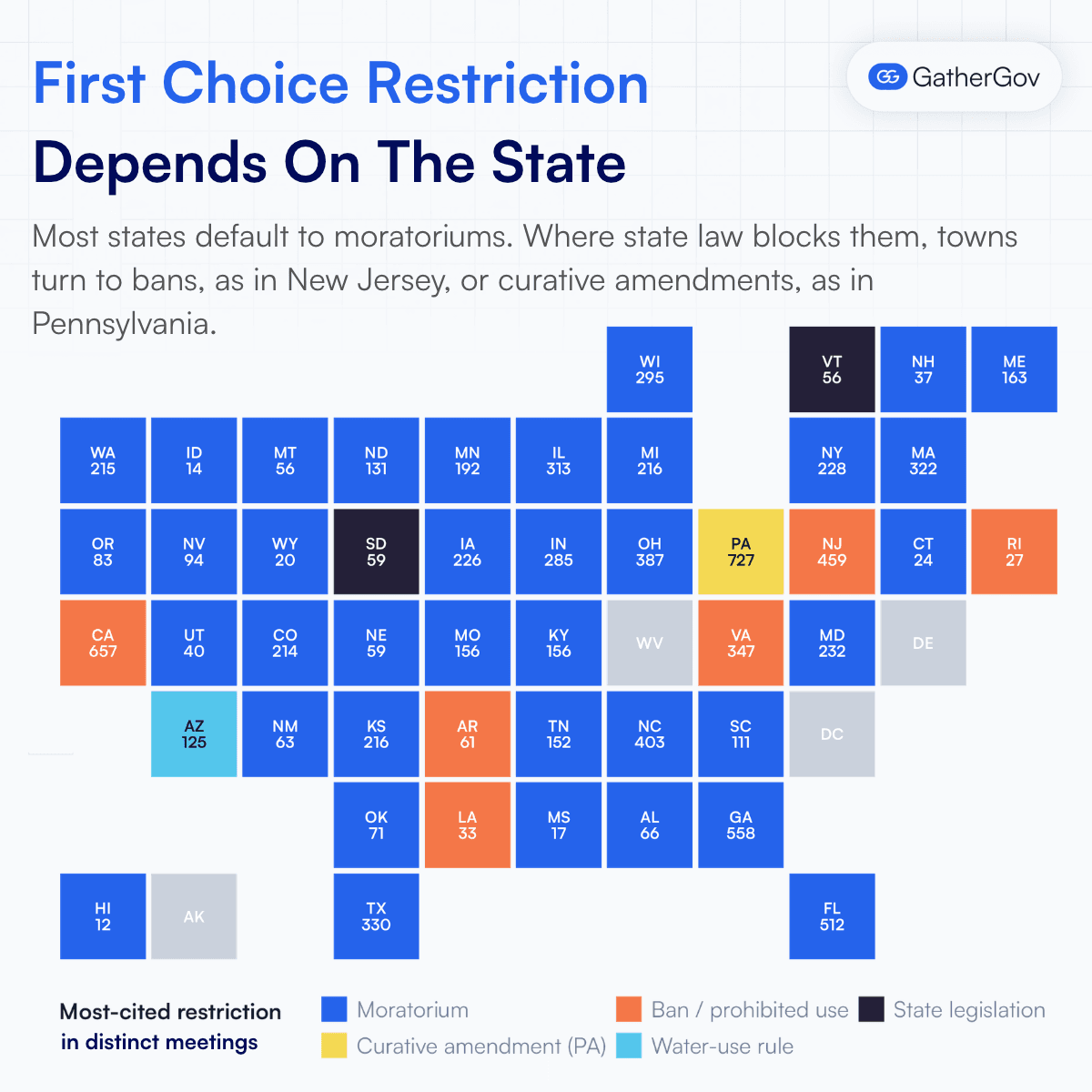 The most popular restriction in each state. Pennsylvania is the only state where curative amendments lead; New Jersey, California and Virginia go to bans.
# Pennsylvania: curative amendments instead of moratoriums
Pennsylvania municipalities cannot enact a zoning moratorium. The state Supreme Court struck down a one-year moratorium in Naylor v. Township of Hellam in 2001, ruling that the state's planning code gives municipalities no power to impose one.[2] Instead, a municipality can declare its own ordinance substantively invalid, for instance because it never contemplated data centers, and then has 180 days to "cure" the defect with new rules.[3]
This is why the term curative amendments barely exists in the data center debate outside Pennsylvania. Of 354 meeting documents in the year that discuss curative amendments, 353 are from Pennsylvania. Lehighton, East Whiteland, Dallas Township, Upper Moreland and Upper Mount Bethel lead the list.
Upper Mount Bethel's solicitor explained the mechanism to residents in July 2026: the township would be declaring its ordinance invalid because it had no definition of a data center and no performance standards for one, which starts the 180-day clock.[4] Bensalem Township made the same unanimous declaration in June, covering data centers, solar and wind at once.[5] Allentown took the other route and rewrote its ordinance directly, after what the administration described as six hours of public comment and a hundred person-hours of staff work.[6]
 Upper Mount Bethel's solicitor explains the municipal curative amendment to residents. Excerpt from the July 24, 2026 township meeting transcript.
# Texas: water, because it is the lever the law leaves
Texas is the clearest case of an instrument chosen by elimination. Counties have almost no zoning authority over unincorporated land, and nearly half of the roughly 248 data centers planned in the state are going there.[7]
When Hood County considered a temporary pause on industrial development, a state senator warned that counties have no power to issue moratoriums, and the commission voted it down. Hill County passed one in May 2026, was sued, and replaced it with a checklist.[8] What the legislature did hand counties, in 2024, was the right to require groundwater availability studies when land is subdivided.[9]
Cities that own their water utility have a second handle: San Angelo now requires closed-loop cooling and caps the water a data center can draw to fill its system, a rule it adopted through its utility code rather than its zoning map.[10] In a state that will not let you say no to the use, you regulate the one input everyone agrees is scarce.
# Arizona: size thresholds, because a ban has a price tag
Arizona cities can zone, but since 2006 Proposition 207 has required them to compensate a landowner whenever a new land-use rule reduces property value. Phoenix found out what that costs. After it restricted data centers near neighborhoods, eleven landowners filed claims totaling about $753 million, and the city has been issuing waivers rather than paying.[11]
Learning from this experience, Tucson, after rejecting the Project Blue campus, chose to implement strict controls over a ban. Any data center above 25,000 square feet or 20 megawatts now needs planned-development zoning with a neighborhood meeting, a hearing officer and a council vote. City attorneys stay, in one resident's words, skittish about an outright prohibition.[12]
The governor's proposed per-gallon surcharge on data center water fits the same logic: it changes the economics without touching anyone's zoning.[13] A megawatt threshold or a water price does not take value from a parcel the way a ban does, so it does not trigger the check.
# Massachusetts and Pennsylvania: caps and noise rules as the defensible middle
Where a town can ban but would rather not be a legal case study, a cap or a performance standard does most of the work with less exposure. Mansfield, Massachusetts, did not prohibit data centers. Rather, it allows facilities up to two megawatts by special permit and bars everything larger townwide, which keeps a lawful use on the books while excluding every hyperscale campus.[14]
Salem's ordinance committee argued over whether adding a two-megawatt line would turn what was formally a ban into an allowance.[15]
Similarly, Pennsylvania towns are landing on noise standards because state law limits their ability to exclude the use. Allentown now measures low-frequency sound in dBC as well as dBA at the receptor, with third-party verification paid by the operator. Compliance there means investing in quieter chillers, enclosures and bigger setbacks—requirements that add to both the initial capital investment as well as the long term operating cost.[16]
 Allentown's noise rules measure the low-frequency hum, not just loudness. Excerpt from the July 16, 2026 planning commission transcript.
# New Jersey: prohibition, fast
New Jersey has the highest restriction intensity in the country, about 20 restriction documents for every 100 data center documents.
Bans lead due to two features of state law. First, the Municipal Land Use Law flatly prohibits development moratoria and interim zoning ordinances unless a qualified health professional certifies in writing that a clear and imminent danger to public health exists.[17] Second, the state's time-of-application rule means the zoning in force when a complete application is filed governs it, so a town that studies the question for a year can lose the race to a developer who files first.[18]
That surfaced at a New Brunswick council meeting in September, where speakers warned that the city's industrial zones still listed data centers as a permitted use.[18] Together, the two rules push towns toward the fastest permanent fix: removing the use. Electric Choice lists New Jersey with 93 municipal bans, the most of any state.[19]
 Why New Jersey towns don't wait: a speaker at the September 2, 2026 New Brunswick City Council meeting on the time-of-application rule.
# Virginia: from by-right to special use permit
Virginia's local governments do not have the power to freeze land-use applications. Loudoun County's own attorney advised its board in September 2026 that a moratorium is not legal in the Commonwealth. So, the board instead moved to defer final votes on pending applications for up to twelve months, which is as far as the one-year decision clock in state law allows.[20]
What a Virginia locality can do is decide how a use is permitted: by right, by special use permit, or not at all.[21] That is why Virginia's signature move in 2026 was procedural. Prince William County, the densest data center market in the world, cut back the area where data centers were allowed by right, so that most new projects now need a special use permit with a public hearing.[22] Where even that feels too slow, Virginia counties reach for the prohibited-use listing, which is why the ban is the state's most-cited instrument.
# Georgia: where a moratorium is one vote away
Georgia sits at the other end of the spectrum. The state tops the moratorium count because a county commission can adopt one by resolution with no special statutory hurdle. Newton County's resolution barred the acceptance of rezoning, special use, permit and building applications for data centers through October 7, 2026.[23]
DeKalb County started its pause in July 2025 and extended it twice, most recently through September 30, 2026, while staff drafted zoning and operating rules.[24] Coweta County adopted a 180-day moratorium covering permits, rezonings, conditional uses, variances and the public hearings that go with them, carving out only the five projects that already held vested rights.[25] When the pause is that easy to adopt, there is little reason to reach for anything else first.
# Everywhere else: the long tail
The rest of the toolkit shows up in specific places for specific reasons.
- Interim development controls stop the clock on new applications. Sedgwick County, Kansas, barred staff from accepting or processing data center zoning and building applications through April 17, 2026.[26]
- Conditional use permits take away certainty. A by-right use must be approved if it meets the code; a conditional use goes to a public hearing where the board can attach conditions or say no. A speaker told Conneaut, Ohio, that this gives the city more control than a moratorium without signaling instability to every other developer.[27] Christiansburg, Virginia, made the same move in August.[28]
- Referendums undo an entitlement. Augusta Township, Michigan, voters repealed a 522-acre rezoning by roughly 90 percent, erasing an approval the developer already held.[29] However, the tool is only as available as state law makes it. In Frederick County, Maryland, a 21,000-signature petition died when courts held the zoning ordinance was not referendable.[30]
# What this means for developers and advocates
The instrument tells you how long the door stays shut and who can open it. A moratorium is temporary by design and legally fragile when it runs long—the Supreme Court has said pauses beyond a year deserve special skepticism.[1]
For a developer, the question is not whether a town is hostile but which instrument it used and when it expires.
 Where each instrument shows up. Each panel is scaled to its own busiest state.
# FAQ
What is a data center moratorium? A temporary pause on accepting or approving data center applications, usually for six to twelve months, while a local government writes permanent rules. Most states allow them; Pennsylvania does not.
What is the difference between a data center moratorium and a data center ban? A moratorium expires. A ban removes data centers from the list of permitted uses in a zoning district, or in every district, and stays until the code is amended again.
What is a curative amendment? A Pennsylvania-specific procedure under the Municipalities Planning Code. A municipality declares its zoning ordinance invalid for failing to address a use such as data centers, then has 180 days to adopt rules that cure the gap. Landowners can also file curative amendments to challenge an ordinance that excludes a use.
Which states have the most data center restrictions? By volume of meeting discussion, Pennsylvania, California, Georgia, Florida and New Jersey. By intensity relative to data center activity, New Jersey, Georgia, North Carolina and Maine.
Can voters block a data center by referendum? Sometimes. Michigan allows veto referendums on rezonings, which is how Augusta Township voters reversed one. Maryland courts held that Frederick County's zoning ordinance was not referendable. It depends on the state and the local charter.
# Footnotes
-
Tahoe-Sierra Preservation Council v. Tahoe Regional Planning Agency, 535 U.S. 302 (2002). https://www.law.cornell.edu/supct/html/00-1167.ZS.html ↩ ↩[2]
-
"Pennsylvania Doesn't Need a Data Center Moratorium," Houston Harbaugh, July 9, 2026. https://hh-law.com/blogs/renewable-energy-zoning-land-use/data-center-moratorium-pennsylvania-zoning-municipalities-planning-code/ ↩
-
Brendan O'Donnell, "Proactive Zoning in Pennsylvania: Addressing Emerging Land Uses Before Litigation Strikes," Houston Harbaugh, May 18, 2026. https://hh-law.com/blogs/renewable-energy-zoning-land-use/proactive-zoning-pa-municipal-curative-amendment/ ↩
-
Upper Mount Bethel Township meeting, July 24, 2026, GatherGov transcript. https://www.facebook.com/100063536348556/videos/2873249086360846 ↩
-
"Bensalem Council Recap, June 8, 2026," Bensalem Weekly, June 10, 2026. https://bensalemweekly.com/?p=13283 ↩
-
Allentown City Council, June 17, 2026, GatherGov transcript. https://allentownpa.granicus.com/player/clip/2087?view_id=1&redirect=true ↩
-
"Texas counties have little power to stop the data centers coming to rural areas," The Texas Tribune via States Newsroom, 2026. https://www.newsfromthestates.com/node/410104 ↩
-
"Eight data centers threaten to transform this small Texas county. Local officials say they have no power to stop them," KSAT / Texas Tribune, June 2, 2026, https://www.ksat.com/news/texas/2026/06/02/eight-data-centers-threaten-to-transform-this-small-texas-county-local-officials-say-they-have-no-power-to-stop-them/ ; "Texas county rescinds data center moratorium after lawsuit," Texas Tribune via Brazos Valley GCD, June 2026, https://brazosvalleygcd.org/2026/06/texas-county-rescinds-data-center-moratorium-after-lawsuit/ ↩
-
"Commissioners call for state action on data center development," Wise County Messenger, 2026. https://www.wcmessenger.com/articles/commissioners-call-for-state-action-on-data-center-development ↩
-
"San Angelo City Council Adopts Water Use Regulations for Data Centers," San Angelo LIVE, June 16, 2026. https://sanangelolive.com/news/san-angelo/2026-06-16/san-angelo-city-council-adopts-water-use-regulations-data-centers ↩
-
"Phoenix faces growing legal pressure over new data center rules," Arizona's Family (KTVK/KPHO), March 26, 2026. https://www.azfamily.com/2026/03/26/phoenix-faces-growing-legal-pressure-over-new-data-center-rules/ ↩
-
"Here is what's in Tucson's new data center rules while city explores ban options," KJZZ, August 6, 2026. https://www.kjzz.org/fronteras-desk/2026-08-06/here-is-whats-in-tucsons-new-data-center-rules-while-city-explores-ban-options ↩
-
Kingman Tri-City Council meeting, January 21, 2026, GatherGov transcript. https://www.youtube.com/watch?v=B-8wzRK2nMI ↩
-
"Mansfield becomes first town in Mass. to pass near-total ban on data centers," Boston Globe, May 13, 2026. https://www.bostonglobe.com/2026/05/13/business/mansfield-data-centers/ ↩
-
Salem City Council Committee on Ordinances, Licenses and Legal Affairs, September 30, 2026, GatherGov transcript. https://www.youtube.com/watch?v=hj1i_tUA7Zk ↩
-
Allentown Planning Commission, July 16, 2026, GatherGov transcript. https://allentownpa.granicus.com/player/clip/2102?view_id=1&redirect=true ↩
-
Guliet D. Hirsch, "Moratoria and the Municipal Land Use Law," Archer & Greiner (New Jersey Law Journal reprint), describing N.J.S.A. 40:55D-90(b). https://www.archerlaw.com/a/web/kppKJTXGLWaMH9AuVdjK6w/hirsch_6313.pdf ; see also "Lawsuit Seeks to Toss Jersey City's Demolition Moratorium," Jersey Digs, 2017. https://jerseydigs.com/lawsuit-against-demolition-moratorium-jersey-city/ ↩
-
New Brunswick City Council, September 2, 2026, GatherGov transcript. https://vimeo.com/1223564659 ↩ ↩[2]
-
"Data Center Moratoriums and Restrictions," Electric Choice, updated October 7, 2026. https://www.electricchoice.com/datacenters/moratoriums/ ↩
-
"Board of Supervisors Votes to Consider Pausing Action on Data Center and Substation Applications," Loudoun County news release, September 2026. https://www.loudoun.gov/CivicAlerts.aspx?AID=10874 ; "Data Center Moratoria Spread Across the DMV," Venable, July 2026. https://www.venable.com/insights/publications/2026/07/data-center-moratoria-spread-across-the-dmv ↩
-
"Virginia localities can say no to data centers. The law decides how," Northern Virginia Daily, 2026. https://www.nvdaily.com/nvdaily/virginia-localities-can-say-no-to-data-centers-the-law-decides-how/article_a3b49985-1a3a-537f-8dde-13276f16c7e6.html ↩
-
"The Window for By-Right Data Center Development in Prince William County is Closing Quickly," Venable, September 24, 2026. https://www.venable.com/insights/publications/2026/09/the-window-for-by-right-data-center-development ↩
-
Newton County Board of Commissioners, Resolution R-040726b (data center moratorium), April 2026. https://www.newtoncountyga.gov/DocumentCenter/View/7830/Resolution-R-040726b ↩
-
"DeKalb County Joins Neighbors With Temporary Data Center Ban," Bisnow; and "DeKalb slams brakes on data center boom after 5-2 vote," Hoodline, June 2026. https://hoodline.com/2026/06/dekalb-slams-brakes-on-data-center-boom-after-5-2-vote/ ↩
-
"Commissioners approve 180-day data center moratorium," The Newnan Times-Herald, 2026. https://times-herald.com/news/commissioners-approve-180-day-data-center-moratorium/article_29dd50b8-88fb-4424-98d9-9d87abfb4588.html ↩
-
Sedgwick County Board of Commissioners, January 14, 2026, GatherGov transcript. https://www.facebook.com/100064553236964/videos/762957683486728 ↩
-
Conneaut City Council, July 13, 2026, GatherGov transcript. https://www.youtube.com/watch?v=e2lpt_iNZ7Y ↩
-
Christiansburg Planning Commission, August 17, 2026, GatherGov transcript. https://www.youtube.com/watch?v=HaEAB-SeOck ↩
-
"Augusta Township voters overturn data center rezoning," WEMU, August 5, 2026. https://www.wemu.org/wemu-news/2026-08-05/augusta-township-voters-overturn-data-center-rezoning ↩
-
"Judge Quashes Frederick Data Center Referendum Petition," Conduit Street, Maryland Association of Counties, June 24, 2026. https://conduitstreet.mdcounties.org/2026/06/24/judge-quashes-frederick-data-center-referendum-petition/ ↩