






GatherGov Logo

Our Mission

Our mission is to solve real estate supply forecasting. In doing so we’re gathering every digital asset produced by local governments - permits, planning meetings, agendas, local codes, and more - to understand every municipality’s story.

Our Leadership

The People Leading GatherGov

  • Tianyou Xu, CEO at GatherGov

    Former PhD in Physics, Oxford University

    Tianyou Xu

    CEO

  • Hardik Bansal, CTO at GatherGov

    Former quant at WorldQuant (Millennium)

    Hardik Bansal

    CTO

  • Mark Murphy, CRO at GatherGov

    Former Head of Sales at Built, and US Olympic Rowing Team Member

    Mark Murphy

    CRO

  • Ovishek Paul, Head of Data at GatherGov

    International Competitive Program Contest World Finalist 2019

    Ovishek Paul

    Head of Data

  • Alexandre Kaiser, AI & ML Lead at GatherGov

    Math Olympiad World Gold Medal Team (Creteil 2019)

    Alexandre Kaiser

    AI & ML Lead

Who we are

We are a group of technologists building advanced tools traditionally available to hedge funds and putting them in the hands of everyday professionals. Technology is the bloodline of our firm. Our team includes former quants, physicists, mathematicians, and competitive programmers with advanced degrees. Real estate supply forecasting is the problem we’ve built our team, culture, and company around. The data is messy, fragmented, and unstructured. We bring quantitative rigor to the problem, and when the tools we need don’t exist, we build them ourselves. If you’re interested in gnarly problems like this, come build with us.

Our Mission

Building America Again

9300+
Jurisdictions
92K
Meeting hours monthly
25+
Municipal boards
735K+
Agendas & minutes
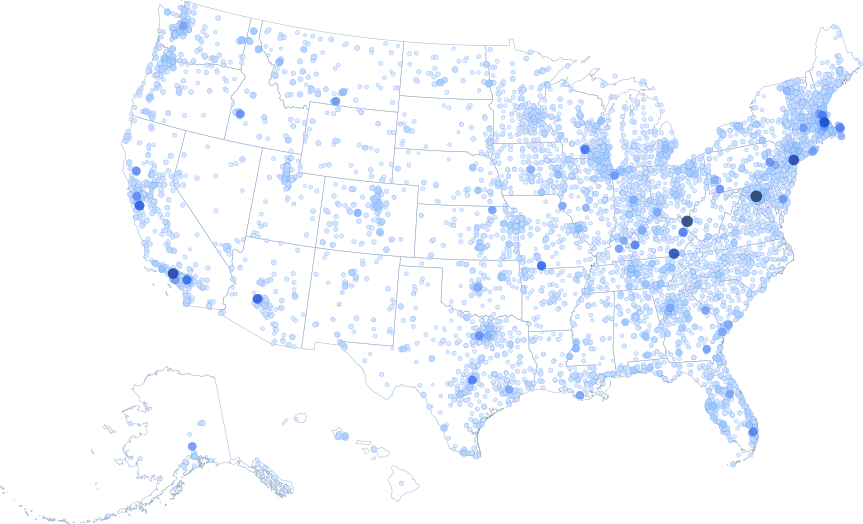
Meeting coverage across the United States, concentrated around major metropolitan areas

The Context

The cost of waiting

The Empire State Building went up in 410 days. The Pentagon was designed and occupied in sixteen months. Hoover Dam finished two years ahead of schedule.

None of that happened because mid-century America had better engineers or cheaper steel than we have now. It happened because the distance between deciding to build something and being allowed to build it was short.

Anyone who develops or builds for a living knows what that distance looks like today. The land is under contract. The capital is committed. The drawings are ready. And the project sits, month after month, inside a process that no one can predict and no one will put a date on.

The constraint on American building is not technology, labor, or money. It is the interface between the people who build and the roughly 90,000 units of local government that decide whether they may.

The System

Where America gets built

"All politics is local" is a popular quote in Washington. Tip O'Neill meant it as advice about elections but it is also a literal description of where authority over the built world sits.

Alexis de Tocqueville understood why, and said it better than anyone since:

“This is the operating design of the country, not a nostalgic observation about it. Washington does not zone land, approve subdivisions, grant conditional use permits, set impact fees, or condition an entitlement on a traffic study. Tens of thousands of separate local bodies do, each with its own code, calendar, quorum, and politics.”

Which means the decisions that determine what gets built in America happen on Tuesday nights, in rooms with a dozen people in them, in front of almost no one. A planning commission vote determines whether 400 homes exist. A comprehensive plan amendment moves hundreds of millions of dollars of capital, or freezes it.

Federal policy gets the coverage. City hall makes the decision.

The Gap

The accessibility gap

Nearly every market in the American economy became legible over the last two decades. Equities price in microseconds. Private companies are instrumented and scored. You can buy satellite imagery of a retailer's parking lots to estimate their quarter before they report it.

Then you try to find out what a county planning commission did with a 30-acre parcel last month.

The agenda was a PDF posted seventy-two hours before the hearing on a site with no search. The discussion is buried in a three-hour video with no transcript. The minutes will appear in six weeks, summarized past the point of usefulness. The staff report that actually explains the decision is item 11 of 14 in a 400-page packet. And none of it is comparable to the county next door, which uses different software, different terminology, and a different meeting calendar.

How the private economy runs Real-time pricing · Standardized filings · Full-text search · Structured APIs · National comparability · Instant alerts

How the local public sector runs PDF packets · No common vocabulary · Video with no transcript · Minutes weeks later · Thousands of separate formats · You had to be in the room

The information is public. Almost none of it is accessible. Those are different things, and the difference is where the cost lives.

The Opportunity

The missing supply forecast

Forecasting is the holy grail, and real estate doesn't have one. Every mature industry eventually builds a supply-side forecast, and in every case it reorganizes the industry around it.

Agriculture has the WASDE. Every grain trade on earth keys off a monthly government estimate of what will be harvested. Oil and gas has rig counts and DUC inventory, and the entire forward curve prices against them. Semiconductors have book-to-bill and announced fab capacity. Utilities have integrated resource plans and load forecasts that determine what gets financed a decade out.

The cleanest analogy is shipping. Charter rates move on the orderbook-to-fleet ratio, because a vessel takes about three years to build and every order is visible the day it is placed. The industry knows its own supply three years forward. That single fact is why maritime capital allocation is disciplined in a way real estate capital allocation is not.

Real estate has none of this. So the industry forecasts demand well and supply barely at all. Absorption models, migration data, employment forecasts, rent comps — all of it is sophisticated. Then supply gets handled with a permit feed and a guess.

The real orderbook for American real estate does exist. It is sitting in the proceedings of local government, eighteen months to three years ahead of the permit, in the form of rezonings, plan amendments, site plan approvals, subdivision maps, and conditions of approval. It has always been public. It has never been readable.

That is the asset we are building: a structured, national, forward-looking record of what is coming out of the ground, where, when, and by whom.

The Impact

What forecasting changes

For owners and developers. Submarket supply risk becomes a number instead of an instinct. You can see what is queued against your delivery window before you close on the land, and you can price entitlement timing by jurisdiction from actual observed behavior rather than from what your consultant remembers about the last one.

For lenders. Concentration risk becomes visible at origination. A construction loan committee can see the full competitive set in the pipeline, not just what has already been permitted. Portfolio-level exposure to a submarket that is about to be oversupplied stops being a surprise that arrives at stabilization.

For general contractors and AEC firms. Pipeline visibility eighteen to thirty-six months out changes how you staff, hire, bid, and position. You can identify projects at the stage where teams are still being assembled rather than the stage where the bid list is closed. Proximity advantage becomes something a firm can have in forty markets instead of the four where it has people.

For investors and allocators. Supply is the variable that most often breaks a real estate thesis and the one that is hardest to observe. A defensible forward supply series makes it possible to underwrite markets against a common standard, benchmark managers on whether they saw it coming, and allocate on evidence.

Every one of these is the same product. What differs is the question asked of it.

The Approach

How we're building it

Three things make this tractable now.

The material is language, and machines can finally read it. Local government runs on agendas, staff reports, ordinances, motions, minutes, testimony, and conditions of approval. It is unstructured text and recorded speech, which is exactly what modern models handle well. Ingesting hundreds of thousands of hours of proceedings, resolving the same developer or engineering firm across dozens of jurisdictions with different naming conventions, and mapping one city's planned unit development to another's specific plan was not possible five years ago at any price.

We are quants first. Data aggregation and extraction is the easier half (still a challenge). The hard half is methodology: probability of approval conditioned on jurisdiction, project type, and applicant history; expected time-to-entitlement with honest confidence intervals; conversion rates from approval to permit to delivery; attrition at every stage. That is statistical work, and we treat it as statistical work. When we publish a forecast, we’re going to be as transparent as we can. A forecast nobody can audit is marketing.

We build it with practitioners, not around them. We work directly with owners, general contractors, research heads who have spent their careers underwriting and delivering projects in these markets. They tell us where our taxonomy breaks, which conditions of approval actually kill a deal, and where a model output disagrees with what they know from the field. That feedback loop is the difference between a dataset that is technically impressive and one an investment committee will rely on.

The Vision

It's time to build again

Tocqueville's insight was that local institutions are where a free people learn to govern themselves. We think the people who build in this country deserve to see the system they have to build through. The capital is waiting. The demand is real. What has been missing is the ability to know what is coming. That is the thing we are building.

#GatherGov Readout

The First to Know Wins. Always.