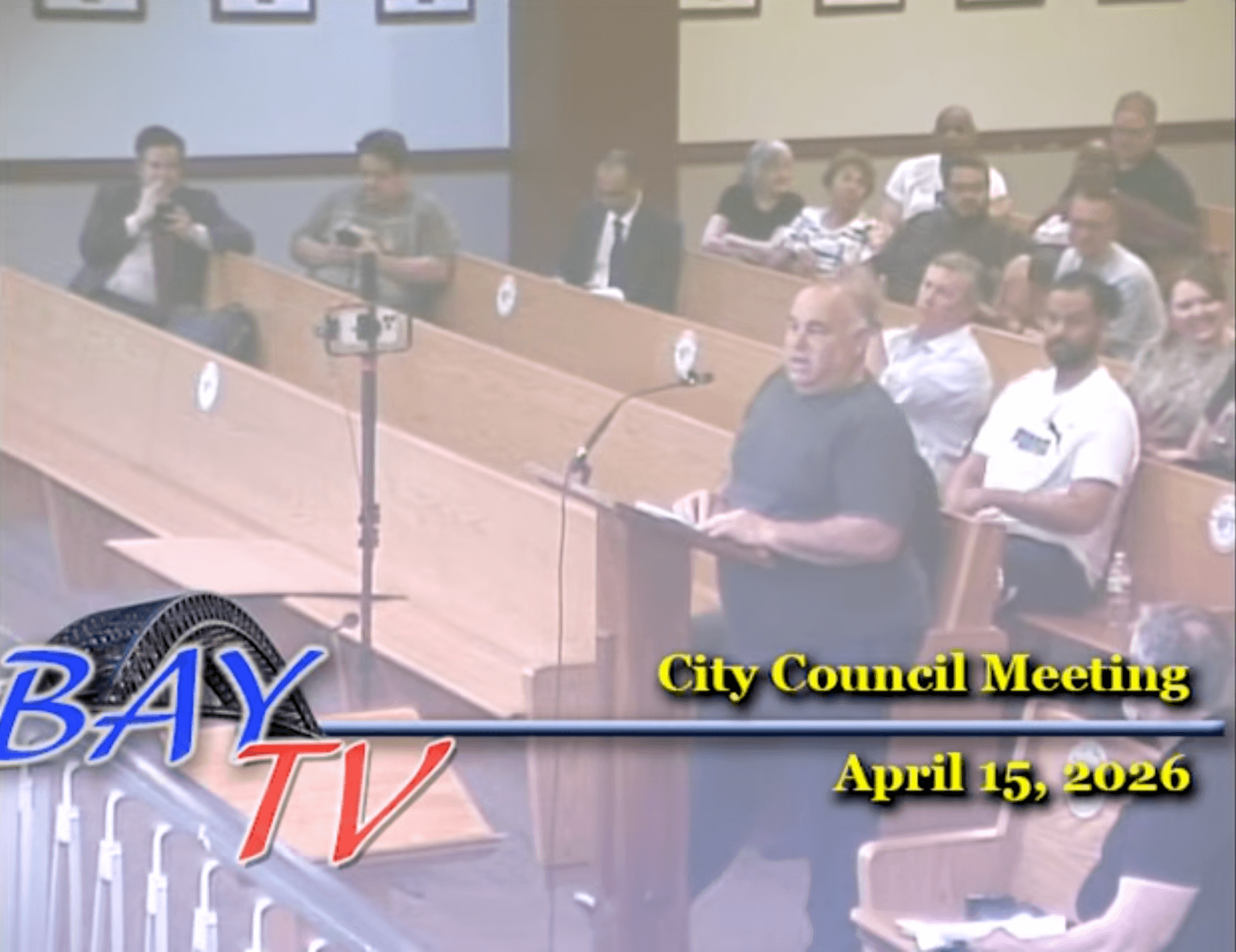
In late April 2026, Bayonne mayoral candidate Sharon Ashe-Nadrowski posted a video to Instagram. The video is a clip of a December 3rd council hearing over an amendment to approve data center use for a former storage facility. It's edited to first show community members who expressed their concerns about the data center, and then cuts to the council members—including her electoral opponent, Councilman Loyad Booker—who voted to approve it.
The caption doesn't pull any punches:
"Last December the Bayonne Planning Board, including Councilman Booker and Planning Board member Veloz, quietly approved a plan to allow a data center to be built right off Route 440, and just over 1,000 feet from a residential neighborhood... This morning, Team Booker put out a misleading statement claiming they have banned all data center development in the city of Bayonne, but that's simply not true."
A follow-up post went further:
"NO to data centers in Bayonne. Always. We need to change our master plan, pass ordinances, and do whatever else is necessary to undo the mess that Councilman Booker, Commissioner Veloz, and the rest of the Planning Board have brought upon this city."
 The backlash against data centers now has consequences on political futures
Ashe-Nadrowski's positioning has added an interesting twist to Bayonne's mayoral race. Her opponent, Councilman Booker, has responded to her claims saying that they too want to ban data centers citywide. While both sides quibble on technicalities, they both implicitly agree on one thing—opposing data centers is the right position to hold heading into May 12.
# This Isn't Just Bayonne
Bayonne is one of many American cities where data center approvals have increasingly come under political fire. Over 422 cities and counties are yet to have their elections in 2026, and in many, data centers will be the sharpest local wedge issues on the ballot. Already, we see that being on the wrong side of the debate can have serious political consequences.
-
In Festus, Missouri, voters ousted every incumbent council member who supported a $6 billion data center project.[1]
-
In Independence, Missouri, two council members were removed the same week after backing a 90% tax abatement for an AI facility.[2]
-
In Warrenton, Virginia, every council member who supported Amazon's project was voted out in 2024 [3]
 Over 40 Million Americans will head to the polls this year for mayoral and city council elections, many of them with data centers on their mind.
So, council members are justifiably spooked. This has caused an unfortunate side-effect for data center developers. In pursuit of proving their mettle to constituents, city councils are stalling all data centers—even those that appear (on paper) to be best use for the land.
# What Was The Bayonne Data Center Project
| Date | Meeting | What Changed |
|---|---|---|
| Dec 3, 2025 | Planning Board | Amendment introduced to the 69–71 New Hook Road Redevelopment Plan adding data centers as a permitted use [4] |
| Dec 17, 2025 | City Council | Ordinance advanced on first reading; applicant Vincent de Monaco represented by Charles Harrington of Connell Foley; Council President Gary LaPelusa Sr. recuses himself from the vote [5] |
| Jan 21, 2026 | City Council | Ward councilmember defends the use as appropriate for Constable Hook's industrial base [^4] |
| Feb 18, 2026 | City Council | Debate continues around $85M+ brownfield remediation and tax base expansion [^4] |
| Apr 15, 2026 | City Council | Overflow crowd; hours of opposition during Statement Period; council commits verbally to block future data centers and research rescission [6] |
| May 12, 2026 | Election Day | Mayor, at-large, and ward council seats on the ballot [^6] |
There are two sides to this story. First, there is the side that community members see, in the larger New Jersey context of data center driven energy price hikes. In June 2025, residential electricity bills across the state's four investor-owned utilities jumped between 17% and 20%.[7][8] PJM attributed 70% of that underlying demand growth to expected data center load.[9]
High profile media coverage of these hikes at both state and national level therefore had primed the Bayonne community to view data centers as a polluting and disruptive industry, whose negative impact can be felt directly on their energy bill.
The actual reality of the situation however, was a bit more complicated. The site in question is 69–71 New Hook Road, a parcel inside Constable Hook—a roughly 1,100-acre heavy-industrial district at the eastern tip of Bayonne, bordered by the Newark Bay. The area has housed tank farms, marine terminals, and petroleum operations for more than a century[10]—creating the densest concentration of legacy industrial use in Hudson County.
This industrial legacy has left significant scars on the land. Much of Constable Hook sits on land that ExxonMobil contaminated over decades of petroleum operations. [11] The city, who had been searching for ways to add these contaminated land back into the tax base was attracted to the redevelopment proposal due to the brownfield remediation economics. A new development there would add significantly to the city's tax base; and any developer that cleans this contaminated land unlocks incentives.
Another attractive feature of this development was its ability to access direct power from Bayonne Energy Center. The site sites adjacent to the BEC and was able to obtain a behind-the-meter arrangement. Any data center at the site would draw power directly from the generator rather than through the utility—which would have insulated the facility from the PJM capacity market, avoiding retail rate increases. [8]
These two features made the project very compelling. As a result, the first hearing of the amendment on a December 3 Planning Board meeting was a relatively boring affair. Staff presented a one-page memo amending two sections of the Redevelopment Plan to add data centers as a permitted use. No major objections were raised.[4]
Two weeks later, the City Council advanced the ordinance on first reading. However, Council President Gary LaPelusa Sr., who wasn't present for the December 3 meeting, recused himself from the vote. The ordinance passed, but the political winds were already changing.[5]
# How It Fell Apart
 The Bayonne Data Center is a planned redevelopment of an existing Delta Storage Facility for data center and warehouse use. The site sits in an industrial zone that was formerly contaminated by Exxon.
Three things converged to unravel the approval.
The first was the NJ rate shock. By the time residents showed up to the April 15, 2026 council meeting, their electricity bills had already jumped significantly—and every news outlet in the state had connected that increase to data center demand growth. [7][8][9]
The second was a separate scandal that eroded public trust. The April 15 meeting was meant to address a different scandal, but data centers came up during the general Statement Period and dominated the rest of the meeting. Residents in the meeting therefore were already fired up about misuse of city seals by private inspection firms and had concerns about transparency and accountability.
The third was the election. With 27 days until Election Day, a packed council chamber, and cameras running, the political calculus invited stronger stances.
By the end of the night, Council President LaPelusa had publicly committed to blocking all future data center applications and researching how to rescind the December amendment. Councilwoman Jacqueline Weimer seconded the commitment. Councilman Neil J. Carroll acknowledged on the record that he hadn't understood a data center was the intended use when he voted yes in December.[6]
What really drove council to make a stand was the diversity of opposition. Residents, a licensed civil engineer, and the NJ Sierra Club all spoke against the project—raising cost pass-through, infrastructure capacity gaps, noise, water consumption, and transparency concerns.[6] Those framings travel easily into campaign materials, and both mayoral candidates have been using them ever since.
# What Happens Next
The December amendment is still formally on the books. A site plan could technically be filed tomorrow. But the practical path forward looks like this:
Short term. The May 12 election will produce at least some council turnover. Any new council will feel the political air just as acutely as the outgoing one. A formal ordinance either rescinding the December amendment or banning data centers outright as a permitted use is likely.
Medium term. Even if the amendment survives rescission, any site plan application will face hostile hearings, demands for enforceable community benefits. The cost structure that made New Hook Road attractive in late 2025 no longer exists in the same form.
Longer term—and for NJ broadly. The state legislative environment is moving in one direction. A bill imposing new tariffs on high-load customers is working through Trenton.[12] Governor Sherrill's "electricity affordability emergency" framing has given municipal-level politicians a statewide permission structure to oppose projects on ratepayer grounds. Any developer running a New Jersey site selection exercise in 2026 therefore needs to account for this political environment.
# The Signal For Developers
The Bayonne reversal is not primarily a story about one site or one city. It's a case study in how fast project timelines can fall apart when an election cycle comes ahead.
The zoning technically still permits data centers at 69–71 New Hook Road. What no longer exists is a council willing to act on that permission—or a political environment in which a candidate could benefit from doing so. That gap between legal entitlement and practical viability is where projects go to die.
GatherGov exists to help real estate professionals navigate the complexities of municipal entitlement. We track risk signals from more than 7200 jurisdictions—public-comment sentiment, council voting patterns, existing development pipeline—helping teams manage site selection, entitlement flows, and community engagement plans. You can read more about Bayonne's development pipeline on its municipality page.
If you want more analyses like this one, subscribe to the GatherGov newsletter. One piece a week, focused on the political and regulatory signals that don't show up anywhere.
# Footnotes
# Footnotes
-
Brian Munoz, "After data center vote, Festus ousts council members," STLPR, April 8, 2026. https://www.stlpr.org/government-politics-issues/2026-04-08/6b-data-center-festus-voters-oust-every-incumbent-council-member ↩
-
"After these Independence councilmembers supported an AI data center, voters ousted them," KCUR, April 9, 2026. https://www.kcur.org/politics-elections-and-government/2026-04-09/after-these-independence-councilmembers-supported-an-ai-data-center-voters-ousted-them ↩
-
"Oklahoma City Council to vote on data center moratorium Tuesday," News9.com, April 2026. https://www.news9.com/politics/oklahoma-city-data-center-moratorium-vote ↩
-
Bayonne Planning Board meeting, December 3, 2025. Amendment to Sections 2.8.1 and 2C1 of the 69–71 New Hook Road Redevelopment Plan. https://www.youtube.com/watch?v=mudS-JIXZaU ↩ ↩[2]
-
Bayonne City Council meeting, December 17, 2025 — first reading of ordinance amending land use at Delta Storage area to permit data center use; applicant Vincent de Monaco, represented by Charles Harrington of Connell Foley. Council President LaPelusa recused. https://www.youtube.com/watch?v=ueud0en9SRg ↩ ↩[2]
-
Bayonne City Council meeting, April 15, 2026 — Statement Period covering both the data center amendment and a separate matter involving misuse of the city seal by a private inspection firm. https://www.youtube.com/watch?v=4FWLhYEcc_0 ↩ ↩[2] ↩[3]
-
Office of Gov. Phil Murphy, "Governor Murphy Unveils Suite of Executive Actions to Address Electricity Prices," May 14, 2025. https://www.nj.gov/governor/news/news/562025/approved/20250514a.shtml ↩ ↩[2]
-
Regional Plan Association, "What's Happening with Electricity Rates in New Jersey?" December 17, 2025. https://rpa.org/news/lab/whats-happening-with-electricity-rates-in-new-jersey ↩ ↩[2] ↩[3]
-
New Jersey Policy Perspective, "Why Are New Jersey's Electricity Bills Going Up, and What Does PJM Have to Do With It?" July 24, 2025. https://www.njpp.org/publications/explainer/why-are-new-jersey-electricity-bills-going-up-and-what-does-pjm-have-to-do-with-it/ ↩ ↩[2]
-
Daniel Israel, "Bayonne considers redevelopment for entire Constable Hook industrial area," Hudson Reporter, September 15, 2022. https://hudsonreporter.com/2022/09/15/bayonne-considers-redevelopment-for-entire-constable-hook-industrial-area/ ↩
-
City of Bayonne, "Scattered Site Redevelopment Project: Phase II," detailing the 1991 ExxonMobil administrative consent order with NJDEP for LNAPL remediation in Constable Hook. ↩
-
Nikita Biryukov, "NJ lawmakers OK plan to charge data centers for spiking electric costs," New Jersey Monitor, February 2026. https://newjerseymonitor.com/briefs/nj-bill-data-centers-electric-costs/ ↩