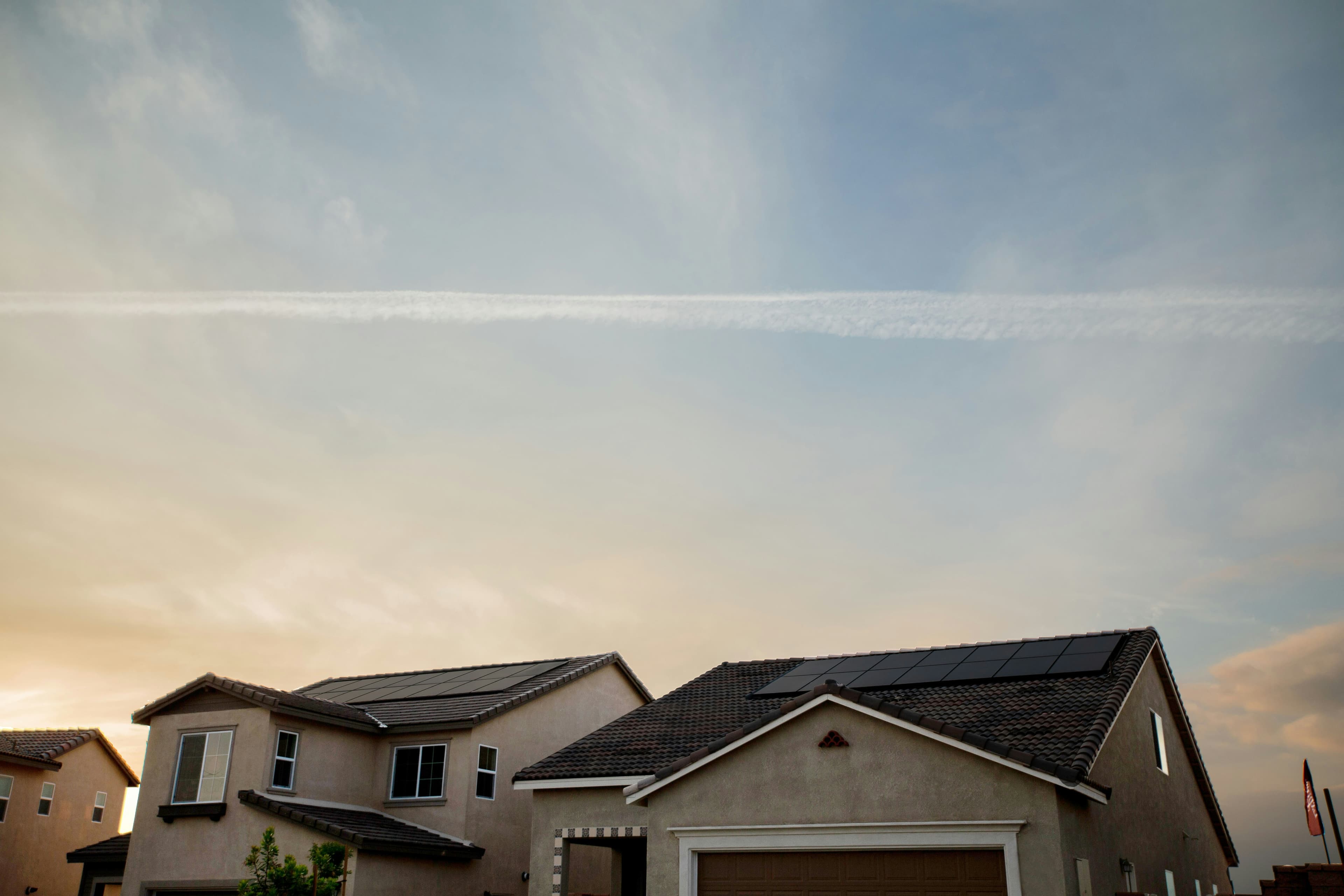
Behind the meter (BTM) refers to when a customer generates or stores electricity on their own property so that the power goes directly to them instead of through the utility grid. Utilities cannot see or track behind-the-meter generation.[1] BTM systems have grown traction as of recent because they are increasingly being used by data centers to bypass slow grid interconnection queues.
# How Behind-the-Meter Generation Works
A behind-the-meter system, whether rooftop solar, an on-site battery, or a natural gas generator, sits physically on the customer's property and feeds the customer's own energy demand directly. The power doesn't technically cross the utility's meter, which means it is not counted as part of its demand. As a result, the utilities and grid operators cannot observe it unless it's reported separately.[1] Its counterpart is "front of the meter" (FTM) generation, where power from a plant flows through the grid and through the customer's meter before it can be used.
At the wholesale market and grid-operator level, BTM generation is treated as its own category with specific rules. PJM Interconnection, the regional transmission organization for a large swath of the mid-Atlantic and Midwest, maintains formal business rules defining behind-the-meter generation and governing how it nets against transmission, capacity, and ancillary service obligations for market participants.[2] BTM generation changes how much power a facility appears to draw from the grid, which affects everything from capacity payments to interconnection studies. As a result, rules regulating these independent energy sources are still important.
# Why Behind-the-Meter Power Matters
Grid interconnection queues for new generation now commonly stretch five years or longer in many regions, and that delay has become the central bottleneck for large power users trying to bring new load online quickly.[3] Data centers, in particular, have turned to behind-the-meter natural gas and other on-site generation specifically to avoid waiting years for grid interconnection, since a BTM system can be built and run on a controllable timeline instead of the years-long queue.
This shift does not suddenly make local government approvals effortless, but it does make them significantly faster; a large BTM generation project still needs land use approvals, air permits, and often gas pipeline access, even though it skips the traditional grid interconnection process. However, for municipalities and counties, that means BTM projects can move through local land use review faster than the region's utility planning process can account for them, with local meeting records as the only early warning system for changes in electricity demand. GatherGov tracks those changes in local meetings.
# What Trips People Up
"Behind the meter" describes a location relative to the meter, not a technology or a size threshold, even though it's often used loosely to mean small-scale or residential solar. A 500-megawatt gas plant built to directly power a single data center is still behind the meter if it never passes through a utility meter before serving that load. The same goes for a rooftop solar panel.
A second source of confusion is that BTM generation is not automatically exempt from utility interconnection review. Depending on the jurisdiction and whether the system will ever export excess power to the grid, a BTM project may still require an interconnection agreement with the local utility, even if it never intends to rely on the grid for its primary supply.
# Related Terms
- Power Purchase Agreement (PPA): the contract structure often used to finance BTM generation assets
- PJM Interconnection Queue: the front-of-the-meter process BTM generation is built to avoid
- Site Plan: the local land use approval a BTM facility still needs even without grid interconnection
- Distributed Energy Resource (DER): the broader category BTM generation and storage fall under
- Front of the Meter (FTM): the counterpart term for grid-connected, utility-metered generation
# Frequently Asked Questions
# What's the difference between behind the meter and front of the meter?
Behind-the-meter (BTM) power is generated on-site and never passes through a utility meter before reaching its load. Front-of-the-meter (FTM) power comes from grid-connected plants and passes through the customer's meter, so the utility can measure and bill for it in the normal way.
# Is behind-the-meter generation the same as a microgrid?
Not exactly. A microgrid is a small, sometimes self-sufficient grid serving multiple buildings that can operate independently of the main grid. Behind-the-meter generation describes any on-site power source relative to a single meter and doesn't require the islanding capability a microgrid typically has.
# Why are data centers using behind-the-meter power?
Grid interconnection queues in many regions now stretch five years or longer, and data center developers need power online much faster than that. Behind-the-meter generation, often natural gas, lets a facility secure power on a construction timeline it controls instead of waiting on the regional grid operator's queue.
# Does behind-the-meter generation still need permits?
Yes. Even though it bypasses the traditional grid interconnection process for new generation, a BTM project typically still needs local land use and building permits, air quality permits if it burns fuel, and often a utility interconnection agreement if there is a possibility that it will ever export power to the grid.
# Footnotes
-
U.S. Energy Information Administration, "Small-scale solar is changing hourly utility electricity demand in New England," Today in Energy, July 29, 2022, https://www.eia.gov/todayinenergy/detail.php?id=53239. ↩ ↩[2]
-
PJM Interconnection, Manual 14D: Generator Operational Requirements, Appendix A, "Behind the Meter Generation Business Rules," https://www.pjm.com/-/media/DotCom/committees-groups/subcommittees/ders/20180608/20180608-item-03-draft-manual-14d-language-btmg-observability.ashx. ↩
-
American Action Forum, "AI Data Center Power Surge: Shifting Trends Toward Natural Gas," May 2026, https://www.americanactionforum.org/insight/ai-data-center-power-surge-shifting-trends-toward-natural-gas/. ↩