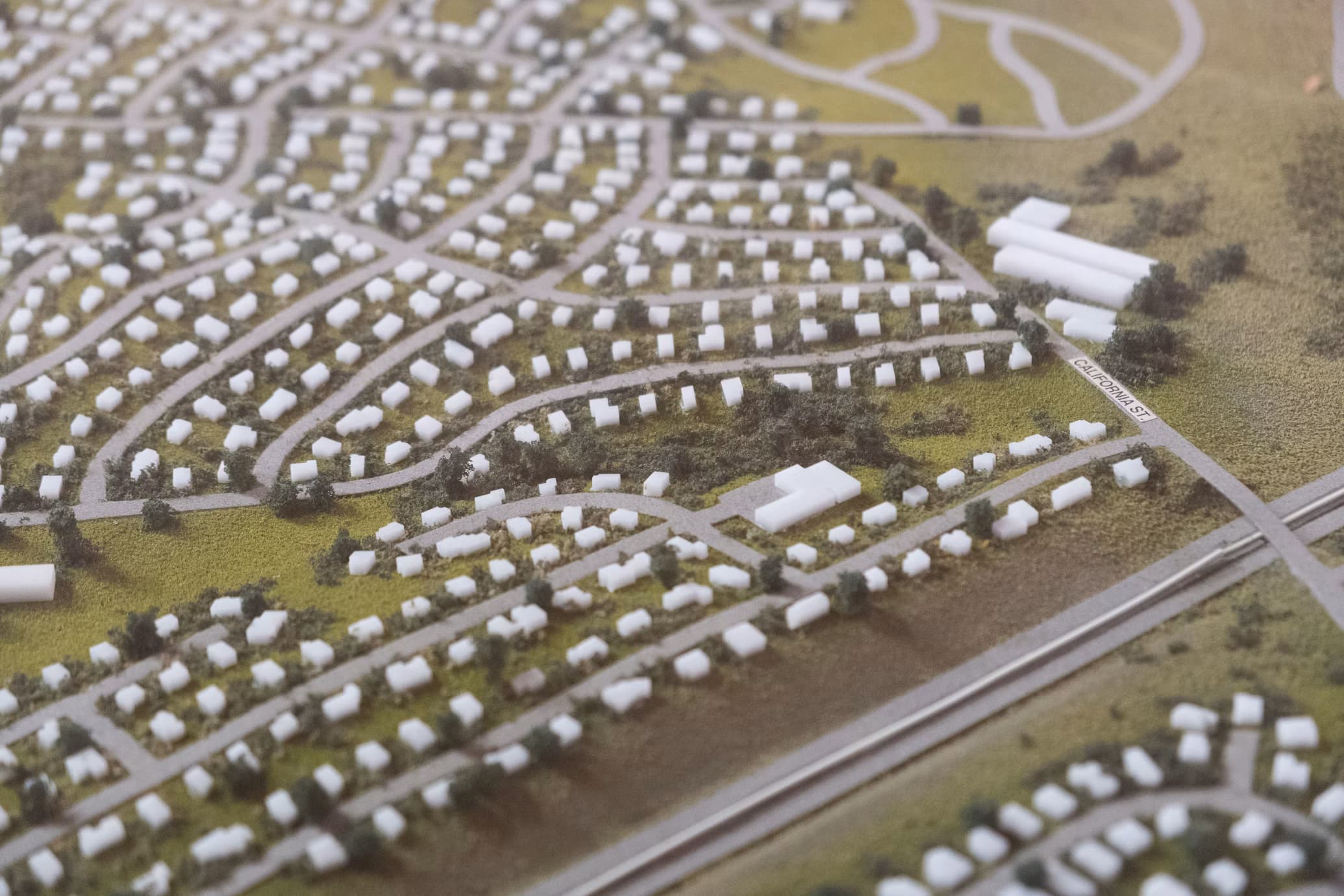
A planned unit development, abbreviated as PUD, is a zoning approach that allows for a custom development plan in place of standard district rules in a specific zone. A PUD often comes in exchange for public benefits created by the developer. A PUD is created with conditions recorded as binding to every future owner of the property. Approval is discretionary and negotiated between the developer and the municipality, and the approved plan, not the base zoning, governs what gets built.
# How Planned Unit Development Works
By nature, a PUD replaces conventional district rules by negotiating a master plan without fixed standards for use, lot size, and setback. Instead, local government approves a set of rules that is tailored to the site and project. A municipality can authorize a PUD in three different ways: as a conditional use, as a modification within the existing base zone, or by rezoning the site into a new planned development district. Rezoning is the most common route.[1] Under it, the local government creates the district and then approves a development plan that fixes uses, densities, open space, and circulation for the site.
Approval typically runs through some version of this sequence:
- Preapplication conference with planning staff, usually non-binding
- Concept plan showing general uses, densities, and site organization
- Preliminary development plan, where most substantive review happens
- Neighborhood meeting, mandatory in many jurisdictions
- Planning commission recommendation, then legislative approval
- Final development plan, which becomes the governing document
Some jurisdictions skip the concept plan and start at the preliminary plan which shortens the timeline but forces the developer to commit spending to designing and engineering the project before knowing whether the density and use mix will survive review [2]. The three-step version costs more time but gives developers more options.
# The Planned Unit Development tradeoff
Ultimately, the tradeoff built into a PUD is flexibility for certainty. Under by-right zoning, you build what the ordinance allows without further discretionary review. A PUD eliminates that entitlement and substitutes it with a negotiated, lengthy approval, which is why timelines vary so widely. For example, the process took roughly six to seven months in Phoenix, but one and a half to three years for smaller projects in San Diego County and up to three years for master-planned communities there.[3]
Additionally, size thresholds vary significantly. Minimum PUD areas range from about 40,000 square feet in some jurisdictions to 20 acres in others.[4] Checking the threshold before assuming your site qualifies is crucial.
Still, the upside of a PUD is substantial. For communities, PUD approval means the open space dedications, affordable housing set-asides, connectivity requirements, and infrastructure commitments. For developers, it means density bonuses and mixed uses that conventional zoning excludes.[5]
# Common misconceptions about PUDs
Similarly to other real estate terms, the name of PUDs vary significantly across handbooks and jurisdictions. The same mechanism appears in codes as planned development (PD), planned area development (PAD), planned residential development (PRD), planned development district (PDD), and several other labels.[6] As a result, simply searching a municipal code for "PUD" and finding nothing does not mean that the tool is actually unavailable.
Second, flexibility is not free. Some ordinances now condition departures from base zoning on a demonstrably superior result. In other words, a PUD has to demonstrate public value to receive continued flexibility. In Sinkler v. County of Charleston, a South Carolina court invalidated a planned development rezoning whose only real effect was to shrink lot sizes, because the governing statute required the district to produce improved design and a genuine mix of uses.[7]
# Related Terms
- Cluster Development: the original form of a PUD, concentrating housing on part of a site in exchange for common open space at unchanged overall density
- Conditional Use Permit: a discretionary approval for a single use, and one of three routes to PUD authorization
- Subdivision Regulations: the parallel control governing how land is divided into lots and what improvements the subdivider must build
- Rezoning: the legislative map amendment most PUDs have to travel through
# Frequently Asked Questions
# Is a PUD the same as an HOA?
No. A PUD is a specific zoning designation approved by a local government, while a homeowners association privately owns and maintains common areas after a project is built. Confusion can stem from the fact that most residential PUDs create an HOA so that common open space can be designate to an owner. Still, the two are distinct.
# How long does PUD approval take?
Anywhere from a few months to several years. In Phoenix, approval was reported to take six to seven months. San Diego County reported one and a half to three years even for smaller projects and up to three for master-planned communities. Whether or not the process includes a concept plan stage, project size and neighborhood opposition delay approval processes.
# Can a PUD be changed after approval?
Yes. A PUD can be changed through an amendment to the approved development plan. Minor amendments usually go to planning staff, while major amendments, including but not limited to changes to use, density, or the overall plan concept, typically require the same legislative body that approved the original. As a result, major amendments often face fresh, vehement opposition.
# Does a PUD have to include housing?
No. PUD ordinances can cover commercial, industrial, and mixed-use projects as well. However, most ordinances use a single format that does not differ by project type. Part of the confusion stems from the fact that PUDs were used extensively for cluster housing in the 1960s.
# Footnotes
-
Daniel R. Mandelker, "New Perspectives on Planned Unit Developments," Real Property, Trust and Estate Law Journal 52, no. 2 (Fall 2017): 235-43. https://law.wustl.edu/wp-content/uploads/2019/04/PUD_Mandelker.pdf ↩
-
Adrienne Schmitz et al., Residential Development Handbook, 3rd ed. (Washington, DC: Urban Land Institute, 2004), 106-07; Mandelker, "New Perspectives," 256-59. ↩
-
Mandelker, "New Perspectives," 260 and n.183 (summarizing 2016-17 interviews with practicing land use planners and attorneys). ↩
-
Mandelker, "New Perspectives," 248 n.100 (citing ordinances in Watertown, NY; Horry County, SC; Broward County, FL; and Bartow County, GA). ↩
-
A Planners Dictionary, ed. Michael Davidson and Fay Dolnick, Planning Advisory Service Report 521/522 (Chicago: American Planning Association, 2004), 309; Mandelker, "New Perspectives," 248-49. ↩
-
Mandelker, "New Perspectives," 231 n.3. ↩
-
Sinkler v. County of Charleston, 690 S.E.2d 777 (S.C. 2010), discussed in Mandelker, "New Perspectives," 251-52. ↩