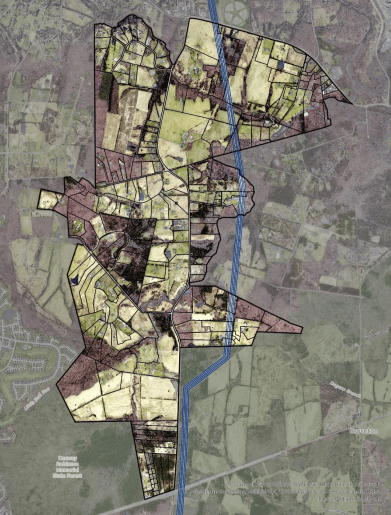
A 27-hour hearing and court ruling that invalidated a county Board’s decision defined the life and eventual death of Prince William’s Digital Gateway. Just a few days later, Dulles South Innovation center, another data center with double the density of the failed project, was unanimously rejected by the board.
These recent tidings underscore that Prince William County's data center market, one of the largest nationally, has reached a dramatic inflection point. The Board of County Supervisors' unanimous rejection of Dulles South Innovation Center combined with the deceased Digital Gateway project signaled an end to the “gold rush” era of un-checked data center expansion to many.
The story has become sensational, making the rounds on social media and news outlets as a devastating, unpredictable loss that points to procedural issues with data center proposals.
Some theorized it failed because of a lack of community engagement. Others theorized it had more to do with parts of the entitlement sequence. In reality, meetings preceding the decision show otherwise; Digital gateway was not an issue of process nor an apocalyptic loss—it was a display of how poor site selection can make denials inevitable.

With the second highest concentration of datacenters in the nation, Prince William County has recently begun heavily scrutinizing data center applications in its jurisdiction.
The Project’s Failed Economic Case
QTS approached selling Digital Gateway like they would any other data center: preach revenue figures and vouch for propelling community benefits such as school investment.
Developers boasted a potential growth in tax revenue of $400 to $700 million, $40 million to $50 million in private infrastructure investment, and a strong multiplier effect on jobs.
Yet, this textbook approach is part of what doomed the project; developers did not pay attention to the potential for Prince William County’s tax code to destroy these benefits, leaving residents to refer to them as “bait and switch” policies; The Local Composite Index (LCI) categorizes the county as wealthier because of valuable data center infrastructure, making the state designate less funding for its schools when developers create infrastructure. As a result, data centers had an opposite effect on the county’s revenue than initially claimed. Furthermore, while Prince William County has historically relied on data centers to diversify its tax base—holding 24% of its major revenue categories—developers have failed to account for a changing fiscal context. Because the county has grown to be oversaturated, it actively loses out on investment from other industries when it approves data center projects. Whether the solution requires compensation or regulatory changes is up for debate, but it is clear that neglecting these harms is what has made Prince William County’s stance on data centers pivot.
A Longer Race for Power
Past simply selling the project, developers failed to consider the feasibility of implementing them in the first place—particularly in ignoring that the county fundamentally lacked necessary infrastructure for such large numbers of data centers. The PJM Interconnection process—the largest power grid operator in the United States— has a backlog of 25 to 30 years. The waiting list, or “interconnection queue,” that it has created is the primary bottleneck preventing sites from starting construction. This problem only worsens in a county like Prince William where demand has rapidly outpaced capacity. On top of the transmission shortcomings, getting equipment for a new substation has become a five-year process.
One proposed solution for developers has been to incentivize them to bring their own generation. From onsite gas turbines to small modular reactors, this practice could prevent grid overload while forcing developers to swallow the costs. In theory, it was the easy solution to these shortages—but in Prince William County, this was not always the case; gas turbines and diesel generators create negative press for the data centers with residents becoming more insistent on deterring development.
It is becoming increasingly clear to government officials that many projects are infeasible and speculative for these reasons. These issues were inherent to the county before development even began; when these concerns were cited as concerns for denial, it was anything but unpredictable.
A Rapidly Changing Political Climate

To make opposition even more impactful, pivotal approval processes are being presented in an election year where all Board seats are up. Politicians’ positions on data centers in such a saturated county can be the biggest factor in election outcomes. In 2024, Board Chair Deshundra Johnson ousted former Chair Ann Wheeler largely on her anti-data center platform.
 In Prince William County, an upcoming election year has made multiple council members more conservative with their votes.
And the record corroborates with this trend; multiple supervisors up for re-election shifted to vote no more frequently than before. Picking the right time—not just the right place—is crucial to an approved project. The failure of data centers in Prince William County are a testament to the fact that ignoring data centers’ roles in political signaling can cost a project.
An Oversaturated Data Center Market
Many developers believed that Prince William County—with its power market and long entitlement history of data centers—was the ideal place to continue building. However, they underestimated the significance of oversaturation in the Board’s voting patterns.
Digital Gateway was far from the only active data center project in the area; the project record shows 33 entitled cases totaling 66 million square feet, with an additional 11 cases active in July 2025. Of these, the Bristow Campus was the first major project to be denied, with the board citing concerns over its location close to schools and historic resources. In recent years, rejection rates in the county have sharply inflated, rapidly shifting from being “rubber-stamped” for financial benefits to unanimous rejections.
Digital Gateway was no exception to this rule; not only did it meet harsh criticism, it was fought with some of the most organized opposition yet. Most vocal were the county’s HOA roundtable, who showed up constantly opposing this development throughout the process. They cited persistent low-frequency noise and “vibrations” as a threat to residents’ health and wellbeing.
Coalition to Protect PWC—a more organized local advocacy group—also showed up in opposition, citing sustainability concerns. A public commentator affiliated with the group stated that the infrastructure required to build Dulles South would “scar” the county’s landscape.
Proponents by comparison, were far and few. Those on the forefront included Union Electricians, property owners, and several business groups. IBEW Local 26—a labor union in the county—came to meetings to praise the opportunities for thousands of high-paying local jobs that come with development. Business Groups like the Chamber of Commerce warned the council that Prince William would “fall behind” other counties if there was stalled development. Some landowners vied for data centers in hopes of selling land.
Still, opposition was the most loud, powerful, and organized. Ironically, the strongest pushback comes consistently from those who already live near data centers. On top of exacerbated shortages, Dulles entered a Prince William County that was fatigued by data centers—something that makes its opposition all the more likely and effective.
Where next?
For real estate developers, the landscape in Prince William County has shifted from “by-right” development—with some counties even trying to attract developers—to a high-scrutiny environment where concerns over public health and environmental justice take precedence over projected tax benefits. Rather than just rejecting one or two projects, the board is cracking down on data centers altogether. Discussions are continuing to scrape the Data Center Overlay District and implement mandatory SUP processes for all sites, with potentially stricter legislation following litigation from landowners. This response in a “data center friendly” jurisdiction has left many developers shocked.
Yet, Prince William County is an exceptional case in many ways. Before projects were even proposed, its resources were scarce, it had already-strong, angry opposition groups, and its tax framework made data centers economically unattractive. As a result, denial became an inevitability.
The consequences of ignoring the county’s inherent incompatibility with data centers underscores the importance of site selection in the development process; instead of focusing on which community benefits to introduce, developers must be more careful in deciding whether it is suitable for them to build a development in the first place. This means being informed, aware, and ahead of the curve. If the first time you read about Prince William County was the final headline, these facts will be a surprise. If you were watching meetings, they would be obvious.
GatherGov monitors public meeting records across 7,800+ jurisdictions and surfaces the entitlement and regulatory signals that precede the headline—so your first read on a county isn't its obituary.