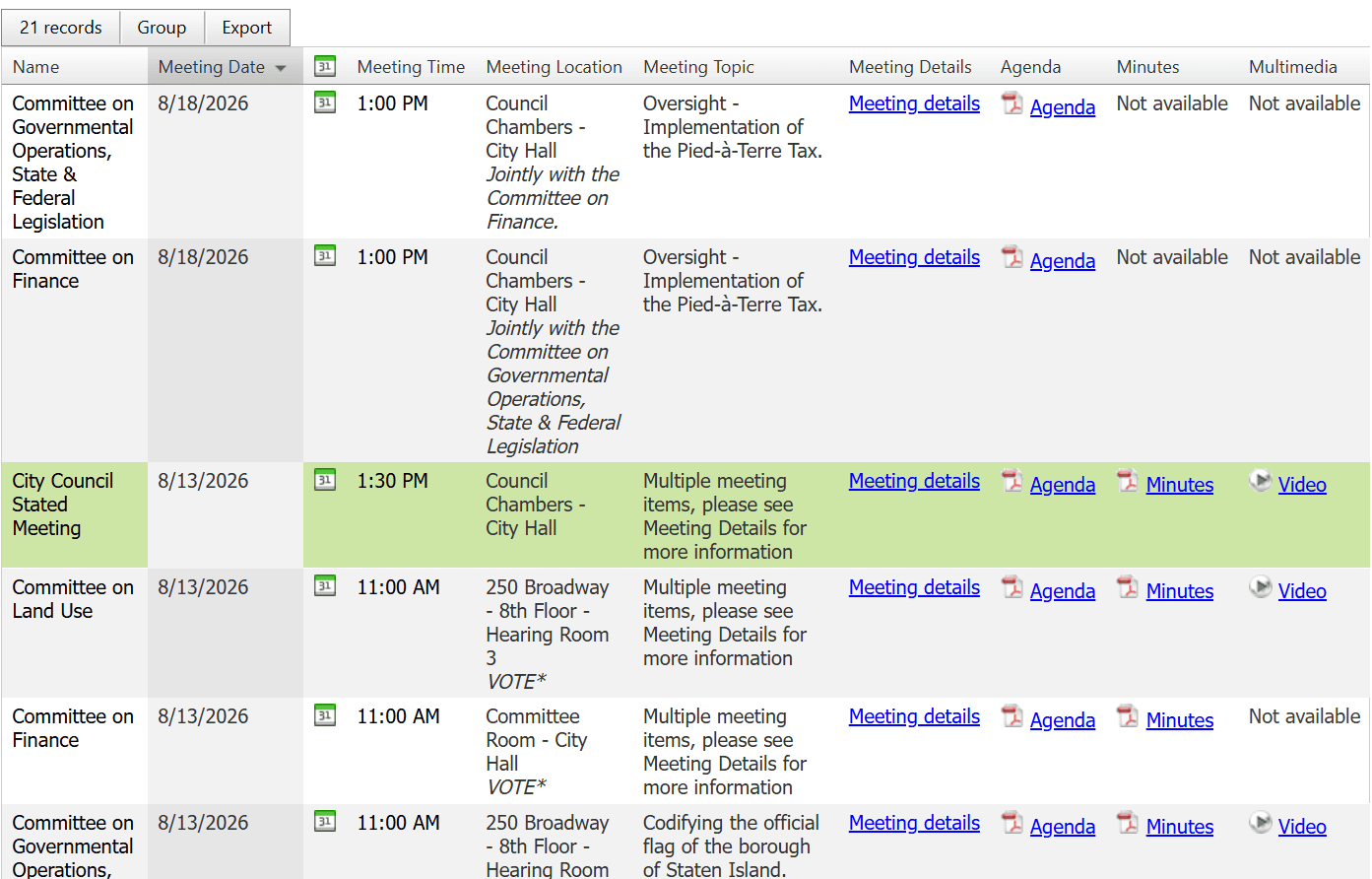
A city council agenda is the official list of items a council will discuss or vote on at a specific meeting, published in advance as mandated under state open meetings law. In most states, the council cannot legally discuss or act on any item that is not listed in its agenda, making it the deadline that governs local decisions.
# How a City Council Agenda Works
The city clerk or manager assembles a council agenda from items submitted by staff, council members, and applicants, and then posts it. This process is not a matter of local preference, but a deadline required under state law.
These deadlines can vary significantly from state to state.
- California requires 72 hours for a regular meeting and 24 hours for a special one, and each item needs a brief description that generally does not have to run past 20 words.[1]
- Texas used a 72-hour clock for decades, then changed it: since September 1, 2025, notice must be posted at least three business days before the meeting date.[2] That shift moved the practical deadline for a Monday meeting from the preceding Friday to the preceding Tuesday.
There are only narrow exceptions to the rule that councils cannot act on or discuss an item not on the agenda: brief responses to public comments and requests to put the matter on a future agenda.[1]
A typical agenda runs in the same order every time:
- Call to order and roll call
- Public comment on items not otherwise listed
- Consent agenda, approved in a single vote
- Public hearings, including rezonings and permit appeals
- Action items, ordinances, and resolutions
- Staff and council reports
- Adjournment
Most agendas come with a packet of staff reports, draft ordinances, and maps explaining what each one-line item actually does.
# Why the City Council Agenda Matters
For anyone tracking a project or a policy, the agenda is the only reliable advance warning that a decision is imminent. Rezonings, variance appeals, development agreements, budget adoptions, and fee changes all surface here first, and the posting deadline is often the last moment to organize a response or submit written comment.
A council can continue an item to a later meeting, but it rarely reopens a closed hearing because someone missed the notice. The practical difficulty is fragmentation: every city posts on its own site, in its own format, on its own schedule. GatherGov indexes agendas and meeting records across jurisdictions so you can see when an item is actually put on a calendar rather than checking dozens of municipal pages by hand.
# Common Misconceptions and Blind Spots
The agenda and minutes are completely different. An agenda lists what may happen; minutes record what the council actually did. Anything listed in an agenda cam be postponed, skipped, or end up with an unexpected vote. Most confusion between the two stems from the fact that different terms are used interchangeably. This is the case in Texas, where the words "agenda" and "notice" are used interchangeably, since cities post the agenda as the legal notice the statute requires.[3]
The bigger trap is the consent agenda. The consent agenda acts a shortcut for routine items, meaning that items placed there are approved together in one vote with no separate discussion, which is efficient for routine business but very easy to miss. When something consequential lands in the batch, that blind spot becomes even more pressing.
# Related Terms
- Consent agenda: routine items a council approves in a single vote
- Staff report: the analysis and recommendation staff attach to an agenda item
- Public hearing: the noticed proceeding where the public testifies before a decision
- Meeting minutes: the official record of what a body decided
# Frequently Asked Questions
# What is the difference between a city council agenda and the minutes?
The agenda is published before the meeting and lists what the council may take up. The minutes are written after and record what happened, including how each member voted. If you want to influence an outcome, you read the agenda. If you want to know what the outcome was, you read the minutes.
# How far in advance must a city council agenda be posted?
It depends on the state. California requires 72 hours before a regular meeting and 24 hours before a special meeting. Texas requires at least three business days before the meeting date as of September 1, 2025. Check your state's open meetings statute, since the number and the method of counting both vary.
# Can a city council vote on something that is not on the agenda?
Generally no. California prohibits action or discussion on unlisted items, allowing only brief responses to public comment, clarifying questions, and requests to put the issue on the agenda for later. Narrow emergency exceptions exist in most states, but they are meant for genuine emergencies, not for regular use or convenience.
# What is a consent agenda?
A consent agenda is a bundle of routine items approved in one vote without individual discussion, such as minutes, contract renewals, and routine appointments. Any council member can usually pull an item out for separate consideration, which is the only way it gets debated.
# Footnotes
-
California Attorney General, The Brown Act: Open Meetings for Local Legislative Bodies, discussing Gov. Code §§ 54954.2 and 54956. https://oag.ca.gov/system/files/media/the-brown-act.pdf ↩ ↩[2]
-
Texas H.B. 1522, 89th Legislature (2025), amending Tex. Gov't Code § 551.043(a) to require posting for at least three business days before the scheduled date of the meeting; effective September 1, 2025. https://capitol.texas.gov/ ↩
-
Texas Office of the Attorney General, Open Meetings Act Handbook (2026 edition), sections on time and accessibility of notice. https://www.texasattorneygeneral.gov/sites/default/files/files/divisions/open-government/openmeetings_hb.pdf ↩